Portable Toilet Cabins in Kolkata: A Complete Guide
Not all portable toilet cabins are built to the same standard, and the differences in quality often only become apparent after people use temporary toilets.
Every temporary worksite or public gathering, be it a residential site in New Town, a road project in Salt Lake, a festival in Eco Park, or an industrial unit in Howrah, needs clean and easily accessible sanitation facilities.
That’s not merely a convenience. It is about worker welfare, hygiene, and regulatory compliance. When sanitation becomes an afterthought, it doesn’t take long before it’s reflected in worker morale, visitor complaints, and ultimately the kind of scrutiny no project manager wants to deal with during an inspection.
No permanent bathroom? No problem. A portable toilet cabin is the answer. These units are for quick delivery and same-day installation. They are ideal for a two-week event or a two-year construction project. These units are ready to go, no plumbers or masons required, and they can be moved as the project layout changes.
Kolkata is growing up. New housing, metro rail extensions, commercial complexes, and a busy events calendar have seen demand for portable sanitation far outstrip construction sites.
Portable toilet cabins have become a trusted solution for contractors, event organizers, schools, hospitals, and government agencies to keep sites clean and visitors comfortable without the cost and delay of civil work.
The city’s monsoon season and dense urban layout also add their constraints: sites are often compact, access roads are narrow, and humidity puts real stress on materials that aren’t built for it.
These cabins require no permanent plumbing or masonry, which means they can be moved as a project evolves -a real benefit on dynamic worksites where the layout in month one looks nothing like the layout in month six. Most modern units also come with ventilation, anti-slip flooring, water-saving fixtures, and weather-resistant materials to stand up to Kolkata’s humidity and heavy rains.
At PortaSpaze, we build portable toilet cabins that meet the real needs of the project, be it a single unit for a small renovation or a whole fleet for a large infrastructure rollout. This guide will assist you in understanding what these cabins are, why demand has gone up across Kolkata, the different types available, how renting versus buying compares, what to check for in terms of build quality, what day-to-day maintenance looks like, and how to pick a provider you can trust.
What is a portable toilet house?
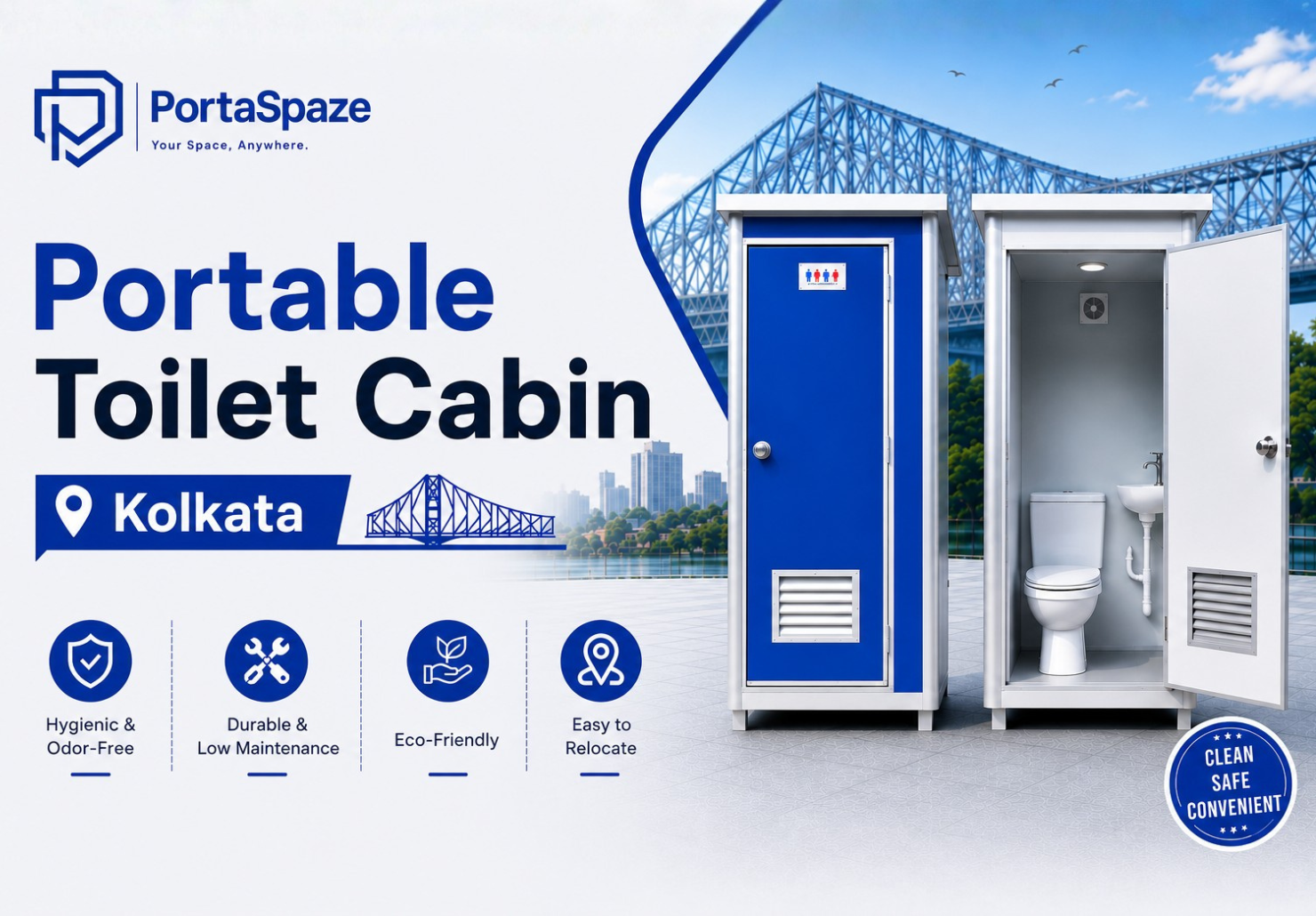
A portable toilet cabin is a prefabricated restroom unit, built off-site and delivered ready to go. No bricks, no plumbing crew, no waiting for permanent construction approvals. They are usually made of FRP (fiber-reinforced plastic), steel, or insulated panels: strong enough to stand up to the weather but light enough to be transported by truck or crane depending on size.
Understanding the manufacturing process is beneficial, as the supplier is equally important; this distinction often determines how projects differ from makeshift toilets assembled on-site.
The panels are molded or fabricated in a controlled factory environment, fittings are pre-installed and pressure tested, and the entire unit is assembled and quality checked before it ever leaves the facility. This process means far fewer surprises once it’s installed – no waiting for a plumber to fix a leak that’s discovered on day three.
Depending on the configuration, a cabin can include the following:
- Indian or Western-type lavatory
- Urinal section
- Mirror and Wash Basin
- Sanitizer dispenser
- Tanks, Storage of Water
- Air circulation and exhaust fan
- Electric lighting, non-slip flooring and lockable doors
- Roof insulation for heat control
- External signage or branding panels
The waste handling also varies from setup to setup, with water flushing, biodigester technology, septic or sewer connections, or chemical storage tanks, which is what makes these units suitable for everything from construction sites to disaster relief camps, where no existing infrastructure is available at all.
Some units are designed as self-contained systems and do not require any external water or drainage connection at all, which is a key consideration for remote sites, highway projects, or flood response operations where nothing else is in place yet.
And relocation does not require demolition, so a cabin can just move with the work. A unit installed near the entrance of a construction site in its early stages can be lifted and moved close to the workforce accommodation once that stage is complete-something that a permanent structure just can’t do.
Why Kolkata requires portable toilet cabins
Kolkata is growing fast in residential, commercial, industrial, and public infrastructure, and there are hundreds of temporary sites and events that need sanitation each year-often at a pace that cannot be matched by providing permanent facilities.
Kolkata’s blend of dense old neighborhoods and fast-growing peripheral areas like New Town and Rajarhat presents two very different but equally urgent problems: retrofitting sanitation into tight, established spaces and provisioning new developments with sanitation before any permanent utility lines are put in.
Major infrastructure projects, such as roads, flyovers, metro expansions, and housing developments, require washrooms for engineers, contractors, and laborers throughout the duration of the build, which can stretch over several years.
It’s impractical or affordable to install permanent facilities at each temporary site, especially when the site itself will be handed back or repurposed after construction is completed. Portable cabins scale to the project: add units as the workforce grows, remove them as phases finish, and avoid sinking capital into structures with a shelf life of a few months.
Growth of the building industry
Construction usually begins long before permanent utilities are in place, but workers need clean facilities from day one, not when the water finally arrives.
Portable cabins offer contractors a quick way to meet workplace welfare requirements, and this demand is becoming ever more important as compliance with labor welfare regulations is being more closely examined on larger, better-resourced projects. Lack of sanitation on a site is not only uncomfortable for workers but is also often highlighted in safety and welfare audits and can slow down progress on the bigger project.
Festivals & Outdoor Events
Kolkata’s calendar is packed with cultural festivals, trade fairs, religious gatherings, concerts, marathons, food festivals, and corporate events. Large crowds need effective sanitation to keep the fun going, and cabins can be strategically placed and immediately cleared out. For event organizers in particular, the calculation is usually around footfall. Undershoot the number of units, and queues become a visible, photographed problem. Overshoot and the additional rental cost eat into margins. And getting this right is one of the more overlooked parts of event logistics.
Emergency response, floods, medical camps, and vaccination drives all create sudden sanitation needs, often in places where infrastructure has either been damaged or was never enough to start with. Portable units can be deployed quickly, with no construction required, and that’s precisely what’s needed when the priority is to get basic services up and running in hours, not weeks.”
industrial activity
Factories, warehouses, and manufacturing units often need temporary facilities during shutdowns, expansions, or short-term workforce surges without interrupting operations. A plant might be in a maintenance shutdown and hire dozens of contracted workers for a few weeks. It doesn’t make much sense financially to build permanent facilities for such a short window of time, but you can’t have those workers without proper sanitation.
Where is a portable toilet cabin used?
Portable toilet cabins are primarily used at construction sites, which represent the largest user base. Clean facilities are a must for laborers, engineers, and visitors to the site in residential buildings, commercial towers, road and metro projects, bridges, and government infrastructure projects. On large sites, cabins are often grouped near labor accommodation and the active work zone. A single set of units serving both ends of a large site is often underused and leads to worse hygiene outcomes.
Outdoor events-weddings, corporate events, music festivals, trade exhibitions, sporting events, and religious gatherings-all gain from shorter queues and improved hygiene. Demand for better-finished units even at short-term events has been driven by the fact that increasingly premium events are treating sanitation as part of the guest experience, rather than a purely functional afterthought.
Industrial facilities install growth projects, conduct annual turnarounds, and mobilize contractors without interrupting production. Sited in industrial sites with strict access and safety procedures, portable units must consider existing traffic flow and emergency egress routes, not just convenience.
Schools, colleges, and testing centers are places where big events, sports meets, or campus renovations happen. In particular, exam season creates short, sharp spikes in footfall that do not lend themselves to permanent facilities, so temporary units provide a practical bridge.
Health camps-vaccination drives, blood donation camps, and mobile health programs for staff and visitors Units with built-in wash basins and more frequent servicing schedules are the norm, as hygiene standards here tend to be stricter than at a typical event.
Government and public projects – municipal works, election activities, disaster response, and community events where mobility and speed are most critical. Election duty, particularly, involves rapid deployment to multiple locations simultaneously on short notice, posing a significant logistical challenge for any supplier.
Types of Portable Toilet Cabins
A small renovation and a large public event have vastly different sanitation requirements. At PortaSpaze, cabins are designed based on user count, duration, available utilities, and site conditions. There is usually more than one “right” design. There is only the right design for a certain project.
The portable bathroom unit is single, compact, and easy to install in restricted spaces, ideal for small construction sites, farmhouses, parking areas, security posts, and small events.
Even at this size, units can be fitted with a toilet, wash basin, ventilation, lighting, and lockable doors. A portable toilet is often where smaller contractors or homeowners renovating low footfall start, but the need for a hygienic, private facility is no different than on a larger project.
Multiple toilet cubicle units
High footfall areas include mega-infrastructure projects, corporate campuses, institutions, and festivals. Separate cubicles, and often separate sections for men and women, reduce waiting times and increase accessibility. Getting this sizing right is a guess at a rough ratio of expected users per unit per hour, with adjustments for peak periods such as lunch breaks on a construction site or interval times at an event.
Cabins with washbasins in the cabin
The toilet includes an integrated handwashing station that features a mirror, soap and sanitizer dispenser, water tank, and drainage system. This design is ideal for food festivals, healthcare camps, and schools, where hand hygiene is crucial and where wash basins located separately from toilet cubicles tend to be used less frequently.
Bio toilet cabins
Using biological processes breaks waste down into safer by-products and doesn’t store it untreated, reducing odor and reliance on sewer lines. Bio-toilets are popular for government projects, eco-tourism sites, parks, and highways-anywhere the location is either environmentally sensitive or too remote for regular waste tanker access.
Bio-toilets are well-suited for longer-duration deployments in locations with limited service access, as they eliminate the need for frequent pump-outs. frequent pump-outs.
Luxury mobile toilet booths
These luxury mobile toilet booths feature premium interiors, Western-style toilets, designer basins, improved lighting, and enhanced ventilation. # Made for weddings, VIP lounges, film shoots, and premium exhibitions where the restroom experience needs to be in keeping with the rest of the event. These units are often finished to a standard closer to a well-appointed home bathroom than a typical site toilet and priced accordingly-but for a client-facing event, the difference is usually worth it.
Portable Toilet Cabin Rental or Purchase
It’s the length of the project, the budget, and how often you’ll need the units. There is no single best choice; instead, it is important to match your commitment to the actual usage patterns.
When to employ
Real but temporary workforce expansion needs exist in various contexts, including construction projects, seasonal events, festivals, sports tournaments, election campaigns, and emergency response.
Why renting makes sense:
No large initial expense, so capital is available for the actual project.
Fast delivery and installation usually occur shortly after order confirmation, and cleaning and servicing often form part of the rental agreement.
Units easily grew or shrank with fluctuations in staffing or attendance figures.
No storage or long-term maintenance issues once the project is done. The units just go back.
When it is worth buying.
Manufacturing plants, permanent construction sites, mining sites, logistics parks, educational campuses, and government departments-wherever sanitation requirements are continuous, not one-time.
Why buying is a beneficial idea:
Low cost for many years of continuous use because rent adds up over time. Full ownership and custom configurations tailored specifically for the site.
Branding opportunities on external panels, which are useful for corporate campuses.
More control over maintenance schedules and standards
Reusable business asset creation for future projects
A quick way to choose
Yes, you should agree to most of the following: renting from most of them. Renting is usually the better fit. The project has a defined end date, and the site location will change again within a year or two; you’d rather avoid ongoing maintenance responsibility. However, if the facility will be serving the same location forever, and you already have or can build a maintenance routine internally, buying generally works out cheaper over a three-year period. Not all portable toilet cabins are built to the same standard, and the differences in quality often become apparent only after a five-year horizon.
Key Features to Consider When Selecting a Portable Toilet Cabin
Not all cabins vary in quality, and the differences often become apparent only after weeks of use. to the same standard, and the difference often isn’t clear until you have used a unit for weeks.
Heavy-duty construction. Materials should be able to withstand heavy use, rain, humidity, sunlight, and repeated transport without deterioration. Cheaper panels are prone to warping or discoloration in a single monsoon season. That’s an expensive problem if the unit lasts only a few years.
Good ventilation. Air vents, exhaust fans, and odor control are most important during Kolkata’s hot and humid summer when lack of proper ventilation can turn a well-functioning toilet into one that nobody would like to use. Passive ventilation alone is usually not enough in this climate; active exhaust systems make a noticeable difference.
Easy to clean. Wall panels are smooth, waterproof, and stain resistant; flooring has rounded corners and effective drainage; all reduce cleaning time and bacterial buildup. A unit that is harder to clean is cleaned less thoroughly, especially on sites with high daily traffic and limited cleaning staff.
Water governance. Freshwater and waste tanks, flush systems, and drainage outlets that work in remote sites where there is no access to external water. Tank capacity should be sized for expected use. If they are too small, they will run dry during a shift and no longer serve their intended purpose.
Safety features: anti-slip flooring, secure locks, adequate lighting, stable structural design, and fire-resistant materials where required. Lighting is one area that is often overlooked but makes a significant difference for units that will be used after dark, either on a 24-hour construction site or for an evening event.
Accessibility: Wider entranceways, handrails, wheelchair access, and low-height fixtures are essential for public works and large events and increasingly expected as standard practice rather than an optional add-on.
Maintenance & Hygiene Standards
A cabin is only half the job; it’s the upkeep that keeps it hygienic, and this is where the difference between a well-run deployment and a poorly run one shows up most clearly.
Daily cleaning for high-traffic sites. Floor sanitization, toilet cleaning, wash basin cleaning, door handle sanitization, waste removal, and consumables replenishment. In sites with heavier usage, more than one cleaning cycle per day may be required to keep pace.
Waste must be disposed of only by authorized providers in approved manners, if required. This practice is important to avoid contaminations and to ensure that the operation is in line with the environmental regulations.
Water refills are checked against actual daily usage rather than a fixed schedule, since usage can spike unpredictably around shift changes, lunch breaks, or event peak hours.
Stocked consumables-toilet paper, soap, sanitizer, air freshener, and bin liners-make it hopeless to run out, and the rest of the maintenance effort is negated almost immediately. Users will see an empty soap dispenser long before they’ll see a full one.
Regular inspections of plumbing, locks, ventilation, tanks, drainage, lighting, and the structural condition of the building prevent small problems from becoming big and expensive ones. A loose door lock or slow leak not fixed usually turns into a much bigger repair a few weeks later.
For larger deployments, it’s a beneficial practice to keep a simple maintenance log per unit-date, cleaning done, consumables restocked, and any issues flagged-so servicing patterns can be reviewed and adjusted rather than left to guesswork.
Problems of worker welfare and compliance
Sanitation is not just a matter of comfort for construction and industrial projects. It also involves wider worker welfare responsibilities that project owners and contractors normally fulfill. A common expectation on any organized worksite, and one of the more visible gaps flagged during site inspections or audits, is adequate and accessible toilet facilities for the workforce.
It’s not just compliance; it’s practicality. Poor sanitation at a site means more absenteeism and less morale, especially among workers who might be on-site for ten or twelve hours on end. Integrating sanitation into basic site planning, rather than addressing it reactively when workers voice concerns, typically results in fewer disruptions and ultimately pays for itself.
The bar is often even higher for government and public-facing projects, as these facilities are visible to the public and reflect directly on the organization running the project.
Cost factors
When sanitation planning is an afterthought rather than part of the initial project setup, a few recurring issues tend to arise. The cost of portable toilet cabins may differ according to a number of factors, and being aware of these factors beforehand will make it easier to compare quotes rather than just going for the cheapest option.
- Type of unit and finish level – a basic single cabin is much less expensive than a luxury unit with premium fittings and interiors.
- Length of rental – longer rental periods will lower the effective daily or monthly rate.
- Number of units-Bulk deployments on a large site typically receive better per-unit pricing.
- Delivery distance and site accessibility can affect logistics costs, especially for sites that are further away from the supplier’s base or have difficult access for transport vehicles.
- Frequency of servicing – More frequent cleaning and maintenance visits will increase ongoing costs but reduce hygiene-related problems.
- Water & waste handling setup-bio-toilets or self-contained systems can have higher upfront costs but cut down on the need for frequent tanker servicing.
Usually the cheapest way to get it is to be specific about actual needs-expected footfall, project duration, and site conditions-when getting a quote, rather than comparing generic packages that may not reflect actual usage patterns.
What Happens: Installing the Product
For those who have never used a portable toilet cabin before, it’s beneficial to have a rough idea of what the process from order to operation looks like.
Assessment of the need. The supplier will discuss site conditions, expected footfall, project duration, and any special requirements around configuration (Indian vs. Western toilets, wash basin requirements, accessibility features, and so forth).
Site assessment (if necessary). For larger installations, a site visit or layout review will help establish the best location, the access route for delivery vehicles, and any groundwork needed, such as a level surface.
Delivery & positioning units are delivered to the site and placed in the agreed layout, usually by truck and, for larger cabins, by crane or forklift.
Connection and commencement. Units are connected to water, drainage, or electrical points as appropriate and checked to ensure that all are working correctly prior to handover.
Service and transfer scheduling: the client is advised on use, and a schedule of cleaning and maintenance is agreed upon for the time of use.
Removal or relocation. As the project develops, units can be moved, added, or removed, and at the end of the project, the rented units are collected, leaving the site clear.
Pre-fabricated units allow for site processes to take hours instead of days, with most lead time occurring during manufacturing or preparation before arrival.
Common Errors to Avoid
A few recurring issues arise when sanitation planning is an afterthought rather than part of the initial project setup.
Not specifying the required number of units and sizing based on total headcount without accounting for peak usage periods (shift changes, lunch breaks, and event intervals) leads to long queues when they are most visible.
Units placed too far from where people work or congregate. But no matter how well maintained, a unit that requires a long walk has far lower usage, which defeats the purpose.
Getting the service intervals wrong can also be a problem. A cleaning schedule that looks adequate on paper often doesn’t hold up once actual usage patterns become clear, especially in the first week or two of a deployment.
Selecting based solely on price. The lowest quote often means lower-quality materials or a less comprehensive service package that might end up costing more in repairs, replacements, or complaints over the life of the deployment.
Sanitation in the last minute. One advantage of portable units is that they can be delivered quickly, but even when delivered rapidly, planning is often rushed and results in undersized or mismatched configurations that need to be corrected later.
As environmental awareness in construction and event planning grows, the portable sanitation industry has been shifting toward more environmentally friendly methods. The most obvious example is the bio-toilet technology, which reduces the environmental footprint and the logistical burden of regular waste removal by treating the waste on the spot instead of transporting it untreated.
Water-saving devices, such as low-flush devices, also reduce total use. This approach is important at places where water supply is unreliable. Portable units generally have a smaller lifecycle footprint than temporary brick structures because they are designed to be reused for multiple projects instead of being built and torn down each time.
If your organization is required to maintain certain sustainability commitments or certifications, choosing bio-toilet or low-water-consumption units and working with a supplier with approved waste disposal practices is an easy way to ensure your sanitation planning is aligned with your broader environmental goals.
How to Find the Best Portable Toilet Cabin Supplier in Kolkata
Choosing the right cabin is only part of the decision, as the supplier is just as important, and this stage is usually where projects tend to either go smoothly or encounter avoidable issues.
Quality of product. Look for FRP, insulated panels, or galvanized steel construction with weather and corrosion resistance, structural stability, and real ease of cleaning interiors. If possible, request to see or inspect a unit in person rather than relying on a catalog image.
Personalization. A suitable supplier should have Indian or Western toilet configurations, single/multi-unit configurations, male/multi-unit configurations, male/female sections, disabled-friendly cabins, a size of water tank, and branding on the outside built around your project, not a fixed catalog. If a supplier offers only one standard configuration, this usually indicates a limited range.
Delivery & Installation Fast delivery, safe transport, professional setup, and site inspection where needed, schedule delays here affect everything else, particularly on projects with a fixed start date.
Support for maintenance. Scheduled cleaning, assistance with the removal of waste, emergency service and availability of spare parts so the cabin remains functional during the project. Find out exactly how they deal with emergency problems such as a blocked drain or broken lock and how quickly they do it. and how soon.
Good name, good experience. If you want to see consistent quality, look at years in business, past projects, and client testimonials. A supplier who has experience in your industry-whether it is construction, events, or healthcare – is more likely to foresee issues that are specific to that environment.
Transparent Pricing. A reputable provider will be able to break down what’s in a quote-delivery, installation, service frequency, and consumables – and not leave these as vague add-ons that you only find out about later.
Why PortaSpaze is the best choice for portable toilet cabins in Kolkata
PortaSpaze provides portable space solutions for businesses, industries, government bodies, and event planners throughout Kolkata. Every unit offers durability, hygiene, and comfort.
Tough Construction – Expertly designed cabins that can withstand the harsh realities of Kolkata’s varied climate.
Bespoke solutions – designed to suit your space, usage, and budget, not just a catalog of one-size-fits-all solutions
Quick delivery in Kolkata & nearby areas – filling the gap between order and installation.
Hygienic design – easy-clean interiors, good ventilation, robust flooring, and maintenance-friendly layouts
We have multi-sector experience in residential and commercial construction, infrastructure, manufacturing, warehousing, government, education, healthcare, events, and disaster relief.
Customer-focused service from the initial consultation through delivery and after-sales support with a team that stays involved rather than disappears after installation.
From a cabin to a fleet for a major rollout, PortaSpaze is built to perform on a regular basis, project after project.
FAQ
What is a portable toilet booth?
A portable toilet unit that can be set up quickly and moved around as needed for use where permanent sanitation is not available.
What is a portable toilet cabin used for?
Construction sites, infrastructure projects, industrial plants, outdoor events, exhibitions, health camps, schools, colleges, public events, disaster relief, and temporary workplaces.
Do I have to hire a portable toilet cabin in Kolkata?
Yes, PortaSpaze offers rental services in Kolkata and surrounding areas for short-term and long-term needs. It is ideal for construction, events, and temporary installations.
Hygienic portable toilet cabins.
Yes, if they are maintained properly, portable toilet cabins are hygienic. Keeping them clean and comfortable to use through regular cleaning, ventilation, and water management – the maintenance schedule is just as important as the unit itself.
Does a portable toilet cabin have to be connected to the sewer?
Not always. Depending on the model, they can be used on waste holding tanks, bio-toilet systems, septic tanks, or existing sewer lines.
Are they adjustable?
Yes. Toilet type, wash basins, urinals, lighting, ventilation, disabled-friendly features, and water tank capacity can be tailored to the project.
Please provide an estimate of the installation duration
Delivery and installation are generally much faster than building permanent restroom facilities because units are prefabricated; actual timing will depend on site accessibility and how many units are being deployed.
How many units do I need for my site/event?
It relies on anticipated attendance and periods of peak usage, not just the total number of people. A supplier who knows your industry should be able to give you a reliable estimate of how many units you need based on similar past projects.
Renting vs. buying: what’s the difference?
Good for short-term, defined-duration needs. No upfront capex. Buying is beneficial for ongoing long-term sanitation needs where the cost evens out over several years of use.
How to select the right cabin?
Or talk to an experienced provider like PortaSpaze: consider user numbers, project length, water availability, maintenance needs, accessibility needs, and budget.
PortaSpaze: Portable Toilet Cabin, Kolkata: Good sanitation is the key to success for any project – a construction site, infrastructure project, industrial facility, or public event. Portable toilet cabins are an economical, timely way to provide sanitation without permanent construction. And as Kolkata continues to grow, so too is reliable portable sanitation becoming more and more essential, not less.
PortaSpaze offers portable toilet cabins for rent & sale for construction sites, industrial plants, commercial projects, infrastructure projects, outdoor activities & public places. Our team will help you to choose the right configuration based on the size, duration, number of users, and budget of your project.
Call PortaSpaze today to schedule your free consultation; contact us, or find us on Google for a customized quote and ensure your project has safe, hygienic, and reliable portable sanitation.