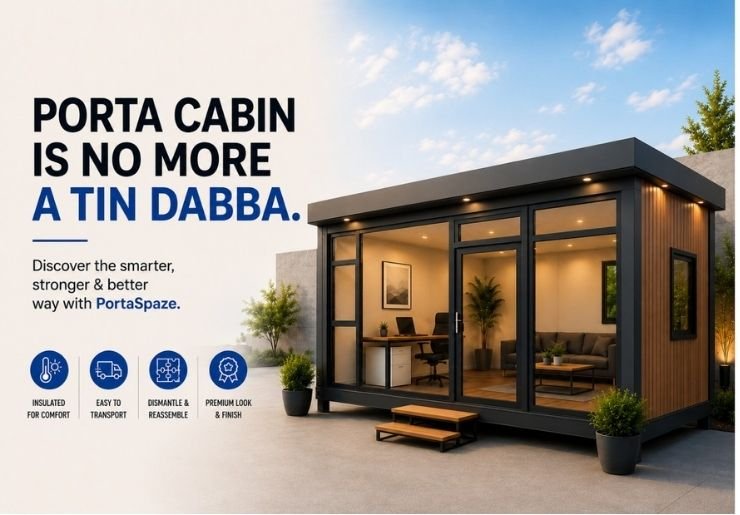
Portable Cabins in Kolkata
If you’ve ever searched for “portable cabins Kolkata,” you’d probably imagine the same thing as most people do: a rusty tin box baking in the sun that doesn’t make for a comfortable place to sit for more than ten minutes and is about as far from “modern workspace” as you can get. That was true ten years ago. It doesn’t any longer.
Portable cabins have quietly become one of the fastest, most affordable ways for businesses, institutions, and homeowners across Kolkata and West Bengal to add usable space – without the six-to-twelve-month wait, the dust, and the unpredictable costs of traditional construction. They are used as site offices on construction sites. Schools use them for extra classrooms when expanding. Hospitals use them for isolation wards and staff cabins. Retailers use them as pop-up stores. Homeowners use them for guest rooms, home offices, and studios.
In this guide, we’ll walk you through everything you need to know before buying or renting a portable cabin in Kolkata – what they really are today, how they compare to brick-and-mortar construction, their costs, where they are feasible, and how to choose a vendor you can trust.
What is a portable cabin, and how have they developed?
A portable cabin (aka prefab cabin, modular cabin, or porta-cabin) is a prefabricated structure built off-site and delivered ready for use – or assembled on-site in days instead of months. The basic idea hasn’t changed much since the first portable cabins appeared on Indian construction sites: build it quick, move it if you have to, and avoid the mess of traditional masonry.
Everything else has changed, pretty much.
Early generation cabins (90s-00s): Bare GI sheet boxes with no insulation, bad ventilation, and a strictly utilitarian look. They were built for one reason, a temporary site office, and they looked and felt like it. This is where the “tin box” reputation comes from, and it was justified for that generation of cabins.
Modern portable cabins (today): Insulated sandwich panel walls (usually PUF – polyurethane foam – or EPS core), powder-coated or pre-painted steel frames, proper double-glazed or UV-treated windows, concealed wiring, modular flooring, and finishes that look like a normal interior space rather than a shed. Many are architect-designed and have the same electrical, plumbing, and HVAC options you would expect from conventional construction.
Demand changed and the shift happened. The cabins are no longer just bought by contractors needing a site office for eighteen months – schools, clinics, retail brands, and homeowners looking for the space to look and feel permanent, even if it isn’t fixed in place, are now buying them.
That evolution is relevant for a city like Kolkata – dense, monsoon-heavy, with land and permission constraints in many pockets. A cabin that can be insulated against humidity, resistant to monsoon flooding at the base, and installed on tight urban plots solves a very specific set of local problems that older tin-box cabins never could.
Busting the “Tin Box” Myth
Let’s address this misconception, as it’s the main reason people hesitate to consider a portable cabin.
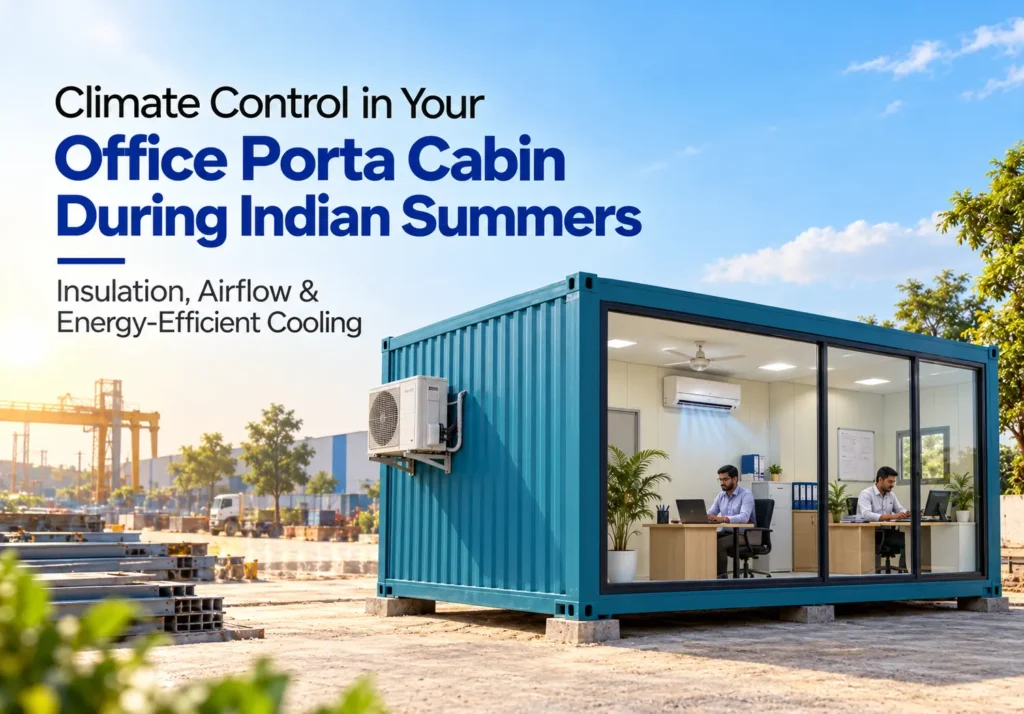
Myth 1: “They’re too hot in summer and too cold in winter.” This claim was true for uninsulated GI sheet cabins. Modern cabins use PUF-insulated sandwich panels (typically 40–100 mm thick), which have excellent thermal resistance, comparable with and in some cases better than a single brick wall. Adequate ventilation and optional AC ducting keep internal temperatures comfortably within a comfortable range even during the peak summer humidity of Kolkata.
Myth 2: “They look cheap and industrial. Today’s exterior cladding options include textured PVC panels, wood-finish laminates, and painted finishes in an extensive color range. Interiors may have false ceilings, laminate or vinyl flooring, and modular partitions – the same finishing vocabulary as used in conventional interiors.
Myth 3: “They won’t make it through the monsoon.” This is a real problem, especially in Kolkata, and one worth asking any vendor about directly. Good manufacturers combat such issues with higher plinths or steel stilt foundations, roofs that slope and are waterproofed, panel joints sealed, and a steel frame coated to prevent rust. A cabin built without any thought to the water table of Kolkata and the intensity of its monsoon will fail, but this is a specification and installation problem, not a flaw in portable cabins as a category.
Myth 4: “They are not safe or durable structures. The majority of modern cabins are engineered structures, with load calculations, wind-load ratings, and often fire-retardant panel cores. They are not informal gatherings but are built to proper structural standards.
Myth 5: “They’re only for building sites.” That is no longer remotely true, as the applications section below demonstrates.
The honest caveat: Quality varies greatly from vendor to vendor. The ‘tin box’ stereotype still holds for the cheaper end of the market. The way around it isn’t to avoid portable cabins completely but to ask the right specification questions before you buy, which this guide covers in the buying guide section.
Benefits of Modern Portable Cabins
Fast implementation. Most portable cabins can be constructed and installed in 1-4 weeks from the time of order, compared to a few months for masonry construction of an equivalent structure.
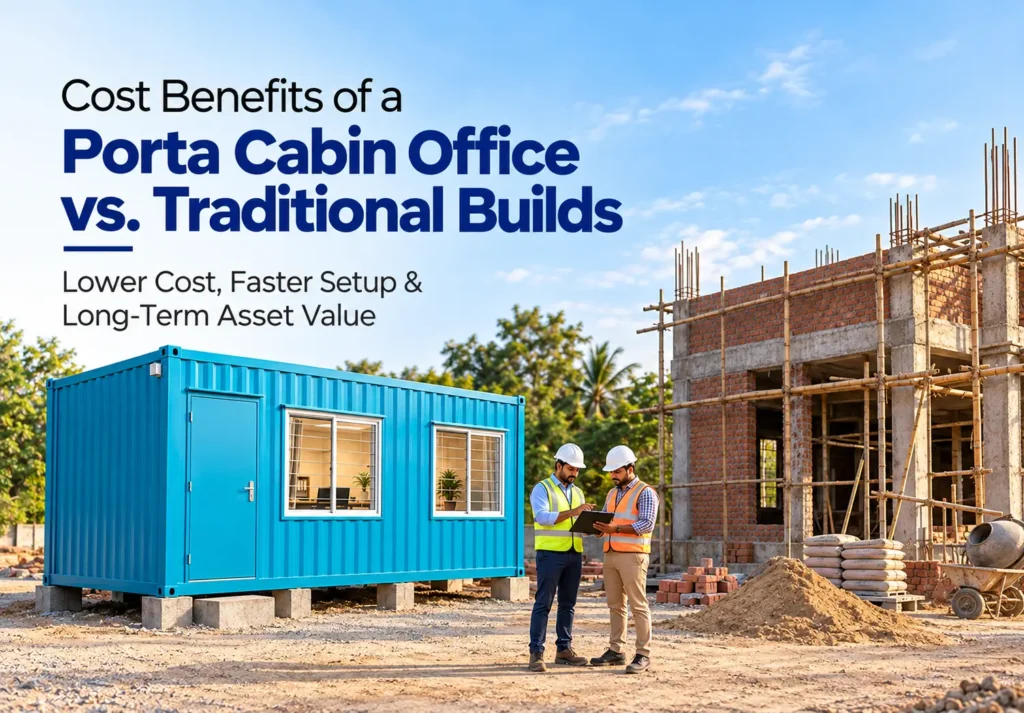
Less money to start. Portable cabins are normally far more cost-effective per sq ft than traditional builds, as materials and labor are optimized in a factory environment rather than an open site. The level of difference varies dependent on the level of specification.
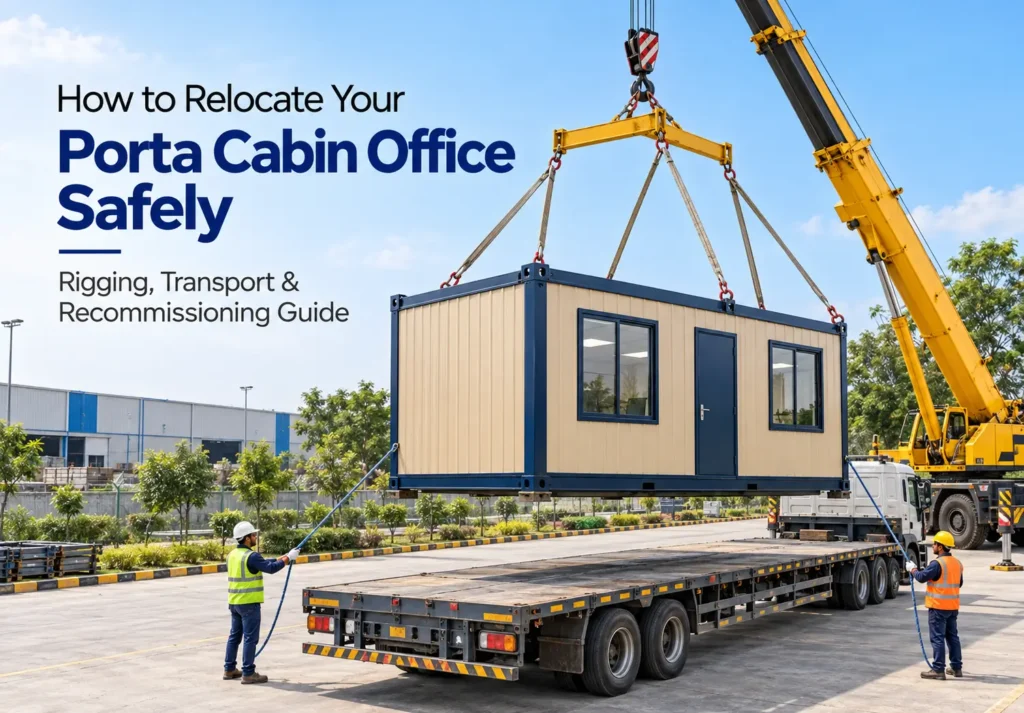
It is relocatable and reusable. A cabin can be taken apart and moved to a new location, which is helpful for construction companies that move from one project to the next or businesses that don’t have long-term security on the land.
Site minimally disturbed. No long-term bricklaying, no piles of construction debris, and no months of dust and noise – a major benefit for cabins that are set up close to busy hospitals, schools, or residential areas.
Fewer approvals needed for temporary buildings. Temporary portable structures often have a lighter approval process than permanent construction (always to be verified locally), which is particularly advantageous for time-sensitive projects. (Note: Approval requirements vary across different municipal wards and land categories in Kolkata. Always confirm with your local authorities or your vendor prior to installation.)
Scalability. We want to order one cabin now and three more in the next quarter. Modular units can be added as needs increase, unlike a fixed masonry building.
More environmentally friendly. Factory-controlled manufacturing results in less waste on-site, and materials can often be reused or relocated rather than demolished.
Portable Cabins vs Traditional Construction
| Factor | Portable Cabins | Traditional Construction |
|---|---|---|
| Typical delivery time | 1–4 weeks | 3–12+ months |
| Site disruption | Minimal | Significant (dust, noise, waste) |
| Cost per sq. ft (typical range) | Generally lower | Generally higher |
| Relocatable | Yes | No |
| Suitable for temporary needs | Ideal | Overbuilt / inefficient |
| Suitable for permanent needs | Suitable with proper specification | Ideal |
| Approval complexity | Often lighter (verify locally) | Standard building approvals required |
| Weather resistance (with proper spec) | Good | Very good |
| Resale / relocation value | Retains value, can be resold or moved | Fixed to land |
| Customisation | Modular, moderate customisation | Fully customisable |
When to choose a portable cabin: temporary/semi-permanent needs; tight deadlines; uncertain land tenure; projects that need to scale up or down; sites where construction disruption needs to be minimized.
When traditional construction is still the better option: permanent, multi-story buildings needs requiring maximum customization or very long design lifespans (50+ years) locations where cabin logistics (crane access, transport width) are truly not possible
Generally, Kolkata’s businesses don’t have to choose exclusively between one or the other – many use portable cabins to meet immediate or auxiliary needs while also pursuing permanent construction.
20+ Uses of Mobile Cabins in Different Industries
Construction & infrastructure
- Contractors and project management site offices.
- Labour Accommodation / Workers’ Housing
- Watchman posts, site security cabins
- Storage huts for tools and materials
- Site engineer and supervisor office
Health care 6. Isolation wards and overflow patient rooms. 8. Doctor/Staff duty cabins. 9. Vaccination and Testing Camp Cabins: 10 booths for diagnostics and sample collection. Pharmacy and reception kiosks
Education 11. 12. Additional classrooms will be added as the school grows. Staffrooms and administrative offices. 14. Campus security booths, hostel warden or guard cabins, 15. Exam control rooms
Retail & commercial 16. Seasonal retail kiosks and pop-up stores are available. 18. Roadside food and beverage vendors 19. Showroom extensions. ATM and banking kiosks 20. Ticket offices and counters
21. Industrial and corporate. 22. Factory floor supervisor booths 23. Corporate campus security and gate cabins are available 24 hours. Temporary offices during the office refurbishment. Warehouse management cabins 25. EV charger attendant booths
26. Residential & lifestyle 27. Guest rooms and house extensions. Home offices and studios. 29. Roof cabins for terrace use, cabins, weekend homes, and farmhouses are available. Gardeners/staff accommodation
This scope is the real story of how the portable cabin category has evolved – from a single-purpose site office to a universal building format used in nearly every industry active in and around Kolkata.
Portable Cabins in Kolkata, West Bengal: Local Perspectives
The geography and climate of Kolkata impose certain requirements that a generic portable cabin specification does not automatically satisfy.
Monsoon & humidity. Monsoon rains lash Kolkata heavily between June and September, and ambient humidity is high for most of the year. Here the cabins are raised on plinths or stilt foundations to prevent waterlogging, have a well-sloped and sealed roof, and are lined with moisture-resistant interior panels to avoid the growth of mold over time.
Summer and hot weather. Summers are hot and humid, so insulation quality – not just cabin size – is the biggest comfort factor. In drier climates, PUF-insulated panels and good roof ventilation are less important than in this country.
Land and access to the site. Industrial and construction sites in and around Kolkata, including Howrah, Salt Lake (Bidhannagar), Rajarhat–New Town, Kestopur, Barrackpore, and the Kona Expressway / NH16 industrial belt, feature varying road widths and crane access. The site dictates whether a cabin is delivered pre-assembled on a flatbed or has to be assembled in modular sections on site.
Regulatory environment. Temporary structure requirements differ across local authorities, such as the Kolkata Municipal Corporation, Bidhannagar Municipal Corporation, and various Gram Panchayats, each with unique documentation expectations. It’s worth checking requirements with your municipal ward office or panchayat if you’re installing cabins meant to stay in place for more than a few months.
Region-specific demand drivers. With infrastructure projects like metro extensions, road widening, developments in New Town and Rajarhat, and healthcare and educational expansion taking place in Kolkata, the need for fast-deployment cabin solutions has gone up.
Buying Guide: What to Check Before You Buy a Portable Cabin
- Type and thickness of panels. Specifically ask for PUF or EPS sandwich panel specs and thickness (typically 40 mm–100 mm). As a general rule, the thicker the panel, the better the insulation.
- Frame material and finish. Check the steel gauge used and if the frame is galvanized or powder-coated to be rust resistant – especially important given Kolkata’s humidity.
- Type of foundation. For Kolkata, ask specifically if base design takes into account monsoon waterlogging (stilt/plinth height, drainage)
- Waterproofing and Roofing. Kindly confirm the roof pitch, shingling overlap, and the quality of the sealant.
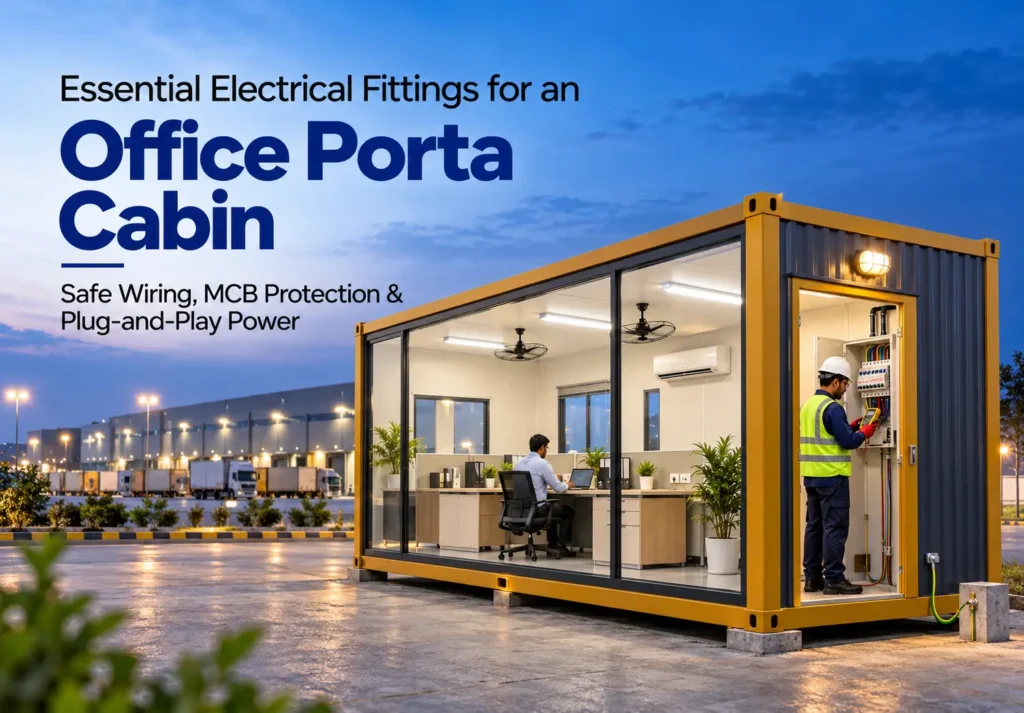
- Electrical specification: Check the wiring standard, load capacity, and whether the fittings are concealed or surface mounted.
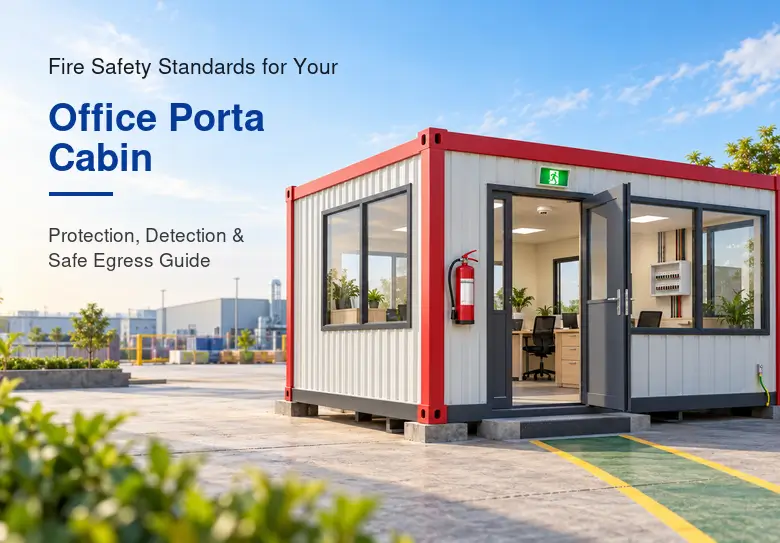
- Fire safety. Ask about the fire retardant rating of the panel cores and fire safety fittings supplied (extinguishers and exits).
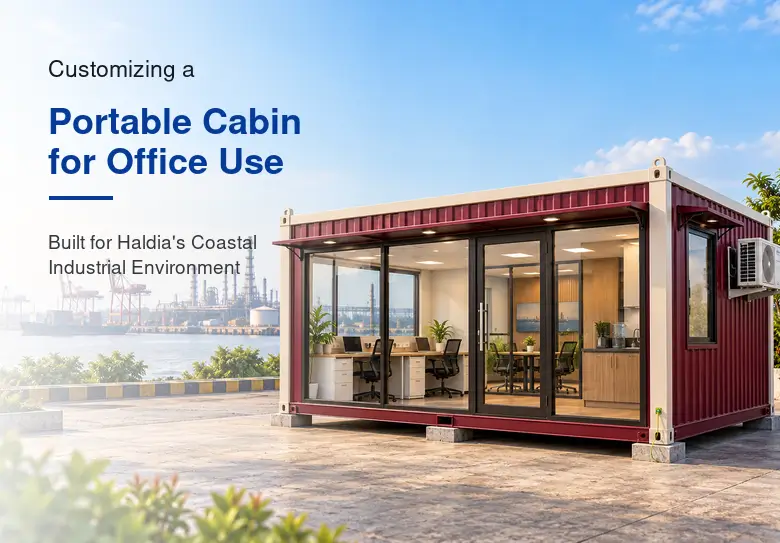
- Customizable items. Standard inclusions, extras on charge: partitions, flooring type, window type, AC provisioning
- Delivery and installation schedule. Get the details in writing, including what happens if site access is delayed.
- After sales and warranty support. Please confirm what is included, for how long, and how service requests are handled.
- Compliance paperwork. See if the vendor will help with the local municipal paperwork for temporary structures.
- Terms of dismantling and removal. If you may need to move the cabin later, make sure it’s possible and know what it will cost.
- References and visits to sites. Ask to see or visit a previously delivered cabin in a similar use case before you sign.
Costs and ROI
The final price of a portable cabin in Kolkata depends on several factors, and quotes can vary widely based on any of these:
- Size (square footage) – the easiest cost driver.
- Panel specification and thickness – better insulation costs more in the short term but saves on long-term cooling costs.
- Number of rooms/partitions – multi-room cabins cost more per sq. ft. than single-room units due to the extra framing and doors.
- Electrical & plumbing fitout. Bare shell cabins are cheaper than fully fitted-out units with washrooms, wiring, and fixtures.
- Depending on the quality of flooring and interior finish, it can range from basic vinyl flooring to a premium laminate.
- Foundation work – Some sites require stilt foundations or extra leveling, making them more expensive than flat, ready-to-go sites.
- Transport distance – the further away a site is from the plant, the higher the logistics costs.
- Rental vs. purchase: Most vendors will do either. Rental is a good option for short-term needs (a few months to 1-2 years). Otherwise, it makes more sense to buy if you have a longer horizon.
ROI considerations: For a construction company, a site office cabin typically offsets the cost of renting nearby commercial space during the project and retains resale or relocation value in the future. For a school or clinic increasing capacity, the ROI argument usually is for revenue or service capacity gained per month of earlier availability versus waiting for conventional construction – often the biggest factor, since a cabin creating usable space in weeks rather than months can begin paying for itself far sooner.
Common Questions
How much does a portable cabin cost in Kolkata?
Cost varies with size, specification, and fitout level. INR 50000 to INR 1000000+
What is the installation time for a portable cabin?
Most standard cabins can be built and installed within 1 to 4 weeks depending on the level of customization and site readiness from the time of order placement.
Is it advisable to use portable cabins in monsoon season in Kolkata?
Yes, provided the cabin has a raised foundation, sloped, waterproof roofing, and moisture-resistant panels – all of which should be checked with your vendor before installation.
Is it advisable to use portable cabins in monsoon season in Kolkata?
Yes, provided the cabin has a raised foundation; sloped, waterproof roofing; and moisture-resistant panels – all of which should be checked with your vendor before installation.
Can we use portable cabins as permanent structures?
Many people use portable cabins semi-permanently or long-term with the right specifications, but for very long design lifespans (50+ years), traditional construction generally better suits the purpose.
Do I need city approval for a portable cabin?
Requirements vary from local body to local body (KMC, Bidhannagar Municipal Corporation, panchayat areas, etc.). Please confirm with your local ward office and vendor prior to installation.
Am I able to move my portable cabin after installation?
Yes, most modular cabins are designed to be taken down and rebuilt at a new location, although you should confirm the costs and feasibility at the time of purchase.
What material is used for modern portable cabins?
Typically a galvanized or powder-coated steel frame with PUF or EPS sandwich panel walls and roofing, but specs vary by vendor.
Is a portable cabin safe during heavy rain and storms?
Yes, if properly engineered with wind load-rated frames and sloped roofing that is sealed. Always check wind and rain resistance ratings with your vendor.
Can we install AC in a portable cabin?
Yes, most modern cabins can take split/window AC units, and some vendors offer pre-ducted options.
What is the difference between a shipping container office and a mobile cabin?
Portable cabins are normally custom-made with lighter-weight frames and more adaptable dimensions, while container offices are repurposed shipping containers and are heavier and have fixed sizes based on standard container sizes.
How many rooms can a portable cabin be?
Cabins can be single-room or multi-room with internal partitions depending on size and layout requirements.
Is there electrical wiring in a portable cabin?
The majority of vendors offer electrical fit-out either as part of the package or as an add-on – check what is included in your quote.
Do portable cabins need a concrete base?
Not always – many will use a compacted plinth or elevated steel stilts instead of a full concrete foundation, which is quicker to install.
Can a portable cabin be utilized as a guest room for living?
Yes, this is an increasing residential case, especially for rooftop or backyard additions.
How long do portable cabins last?
When properly maintained, cabins can last well over a decade, and the quality of the panels and frame plays a big part in that.
How is renting a portable cabin different from buying one?
Renting is for short-term needs (months to a couple of years) with lower up-front costs. Buying is for longer-term or repeated use and retains the asset value.
Can portable cabins be customized for branding purposes (e.g., retail kiosks)?
Yes, the exterior cladding, signage mounts, and color schemes are usually customizable for branded retail or kiosk use.
Are portable cabins firesafe?
Some reputable manufacturers will also supply fire retardant panel cores and can advise on fire safety fittings – but always check this specification with them directly.
What area does a manufacturer based in Kolkata normally cover?
New Town, Rajarhat, Eco Park vicinity, EM Bypass, Sector V, Behala, Joka, Airport Road, Baruipur, Sonarpur of PortaSpaze in West Bengal
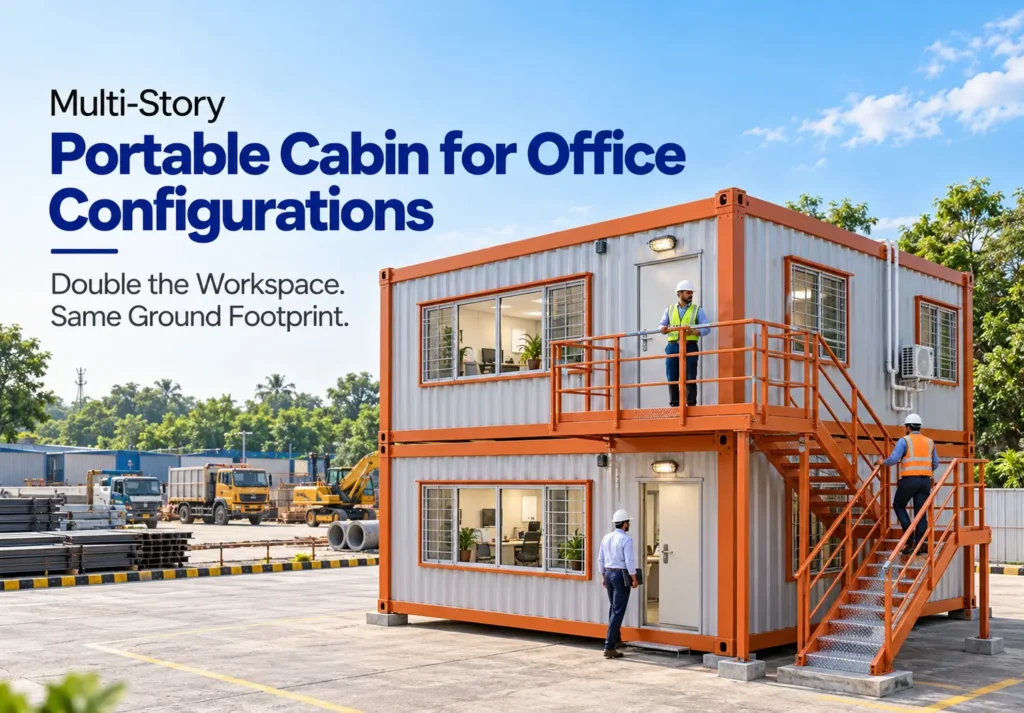
Can portable cabins be stacked or built as multi-story units?
Some modulars can be double-storied, but it is contingent upon the structural specification. Check with your vendor to see if it will work.
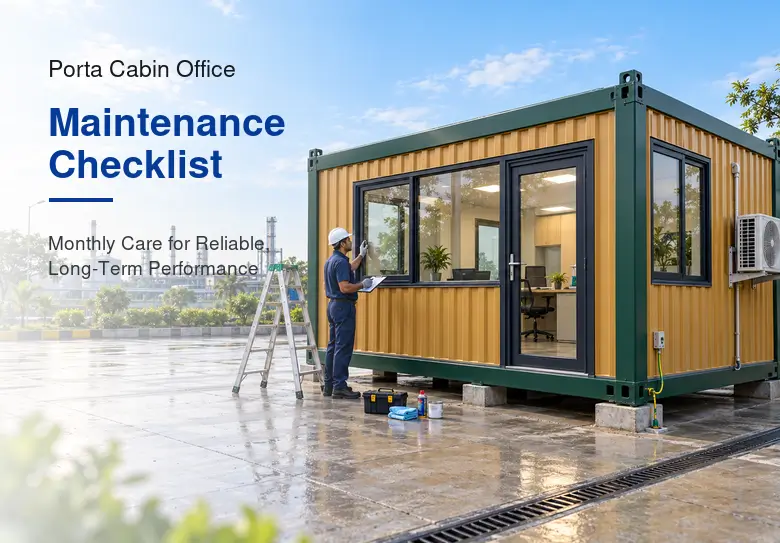
What Maintenance Do Portable Cabins Need?
Generally it is advisable to get the roof sealant, the panel joints and rust spots checked from time to time. It is a humid city of Kolkata so…
Are portable cabins suitable for education and healthcare?
Yes, they are used a lot for extra classrooms, staff cabins, and healthcare support spaces. Provided the specification meets the requirements for usage (ventilation, hygiene-friendly finishes, etc.).
What is the minimum and maximum size of portable cabins?
Size is generally modular and can range from small single-room units to larger multi-room configurations – 10×10, 20×10.
How do I know if a portable cabin vendor is reputable?
Ask for references to the site, compare the specifications of the panels and frames in writing, verify the warranty conditions, and, where possible, visit a cabin already delivered before placing an order.
Conclusion:
The “tin box” image of portable cabins is a decade old. Portable cabins today are engineered, insulated, and finished spaces that can be deployed in weeks, not months – and for a city like Kolkata, where monsoon resilience and fast deployment are both critical, a well-specified cabin can beat traditional construction on almost every practical dimension apart from permanence.
It is specification and vendor quality, not the category, that differentiates a portable cabin that will last and perform from one that perpetuates every old stereotype. If you are looking at options around Kolkata or other parts of West Bengal, use the above buying guide checklist as your starting point, but do not be afraid to ask vendors the tougher questions about panel thickness, foundation design, and monsoon-readiness before you commit.
Are you looking for a portable cabin solution for your project?
Call PortaSpaze today to schedule your free consultation; contact us or find us on Google for a customized quote and ensure your project has safe, hygienic, and reliable portable sanitation.