A construction project needs more than labor, machinery, and materials. It also needs a place where people, plans, and decisions come together.
Project managers need a workspace. Engineers need somewhere to review drawings. Contractors need to coordinate activities. Procurement teams need to manage documents and materials. Clients and consultants may need a professional space for meetings.
Traditionally, construction companies have created temporary site offices using brick, concrete, steel sheets, or other conventional construction methods.
But there is now another option:
Portable office cabins.
Designed as prefabricated, relocatable workspaces, portable office cabins can be installed at a project site without building a conventional office from scratch. Modern prefab site offices can incorporate insulation, electrical systems, windows, flooring, air-conditioning provisions, partitions, and other office requirements. (Portable Office Cabin)
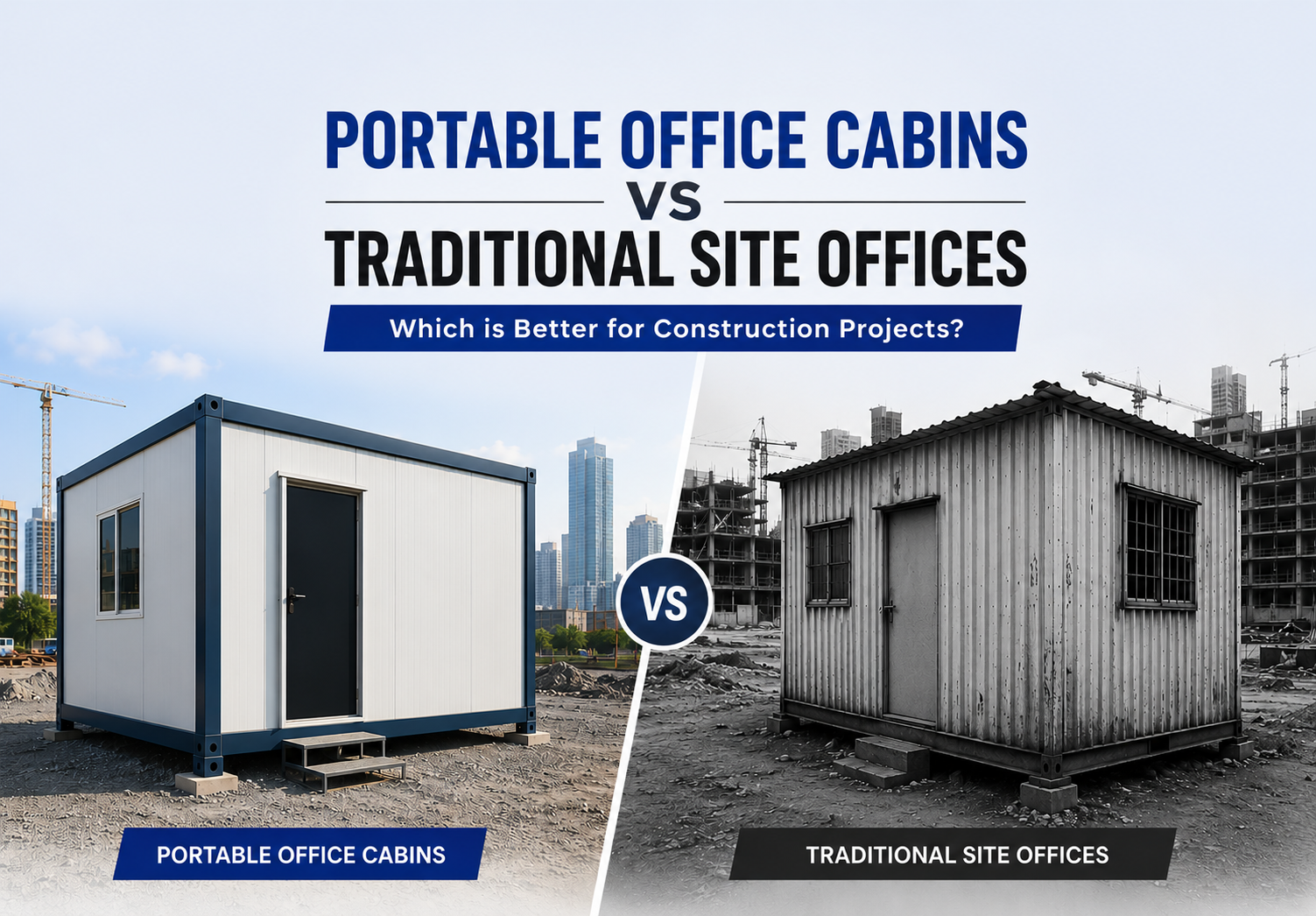
So which is better for a construction project?
Portable office cabins or traditional site offices?
The answer depends on the project, but when speed, flexibility, reusability, and minimal site disruption matter, portable office cabins can offer significant advantages.
Let’s compare both options in detail.
What Is a Portable Office Cabin?
A portable office cabin is a prefabricated workspace manufactured partly or substantially off-site and transported to the project location for installation.
It can be designed in the following ways:
- A project manager’s office
- Site engineer’s office
- Contractor’s office
- Meeting room
- Documentation room
- Sales office
- Reception
- Office + storage
- Office + pantry
- Multi-room site office
Depending on the design, portable offices can use steel frames, insulated panels, flooring systems, electrical fittings, windows, doors, and other components to create a functional workspace. (Portable Office Cabin)
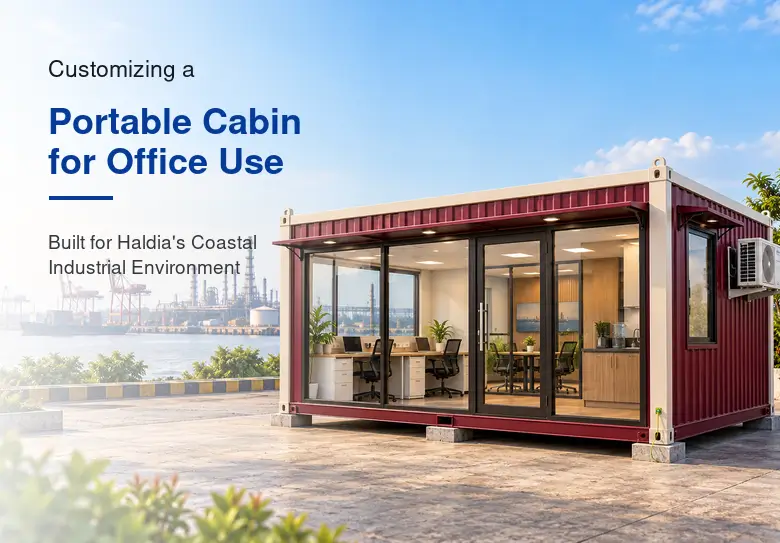
Modern portable offices can be designed to look professional, comfortable, and suitable for client-facing environments, unlike the basic “site cabin” image that many people still hold.
And importantly, many systems are designed to be relocated or reused when the project requirement changes. (Portable Office Cabin)
What Is a Traditional Site Office?
A traditional site office is generally created by constructing a temporary or semi-permanent structure directly at the construction site.
Depending on the project, it may involve:
- Brickwork
- Cement
- Sand
- Concrete
- Steel
- Roofing
- Plaster
- Paint
- Electrical work
- Doors and windows
- Flooring
- Plumbing
The structure is constructed specifically for that location.
This approach makes sense if the office is meant to be a permanent part of the development or if the project has enough time and space for conventional construction.
But for a temporary project office, there is an important question:
Why build a temporary office using a process designed for permanent construction?
That is where portable cabins become particularly relevant.
Portable Office Cabin vs Traditional Site Office: Quick Comparison
| Factor | Portable Office Cabin | Traditional Site Office |
|---|---|---|
| Installation | Fast assembly / placement | Requires on-site construction |
| Construction activity | Minimal at site | Significant |
| Mobility | Relocatable | Generally fixed |
| Reusability | High potential | Usually limited |
| Design flexibility | High | High, but construction-dependent |
| Site disruption | Low | Higher |
| Expansion | Modular options possible | Requires additional construction |
| Insulation | Can be integrated into panels | Depends on construction |
| Appearance | Can be modern and customized | Depends on design and finishes |
| Dismantling | Designed for disassembly in many systems | Demolition usually required |
| Material wastage | Can be reduced through controlled fabrication | More site-dependent |
| Best suited for | Temporary/relocatable project needs | Permanent or long-term fixed structures |
The exact performance depends on the cabin construction system, specifications, site conditions, and installation method.
1. Speed of Installation
Construction projects operate against deadlines.
Every week spent preparing site infrastructure is time that could otherwise go toward moving the actual project forward.
A traditional site office may require:
Foundation → Masonry → Roofing → Plaster → Electrical → Flooring → Painting → Finishing
A prefabricated office can shift much of that work away from the construction site, with components manufactured in a controlled environment before being transported for installation. Industry sources commonly highlight faster installation as one of the main advantages of prefab site offices. (SEAS Homes)
Traditional Site Office
Construction happens largely on-site.
Portable Office Cabin
Much of the fabrication happens before the cabin reaches the site.
Winner for speed: Portable Office Cabin
2. Site Disruption
A construction site is already a busy environment.
You have:
- Excavation
- Concrete work
- Material movement
- Heavy equipment
- Labour
- Deliveries
- Dust
- Noise
Adding another conventional construction activity for the site office can increase congestion.
A portable office can reduce the amount of construction activity required at the location because the major components are prepared beforehand.
That can make site setup more organized, particularly when the project needs an operational office early.
Winner: Portable Office Cabin
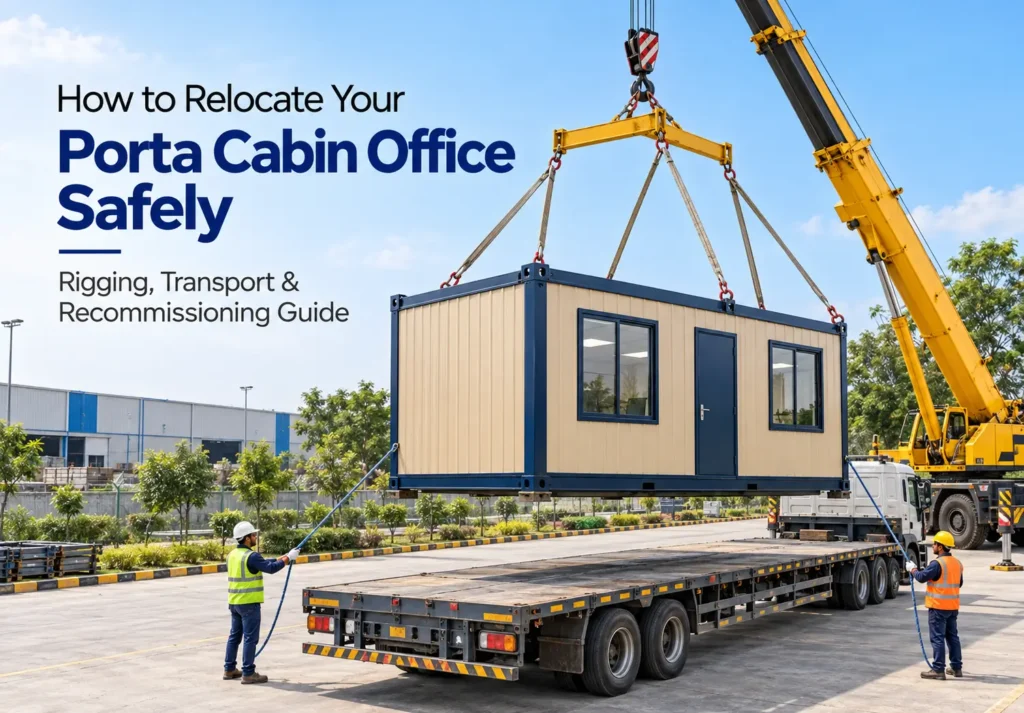
3. Mobility and Relocation
This is perhaps the most significant difference.
A traditional site office is constructed for a particular location.
Once the project is completed, the structure may need to be
- Demolished
- Dismantled
- Abandoned
- Repurposed with limitations
A portable office, by contrast, can be designed as a relocatable structure.
Depending on its construction system, it can be
Installed → Used → Dismantled → Transported → Reinstalled
This makes it particularly useful for contractors and developers managing multiple projects.
Some prefab systems are specifically designed to be dismantled and transported to another project rather than demolished at the end of the first project. (SAMAN POS India Private Limited)
Winner: Portable Office Cabin
4. Reusability
Consider a contractor working on three projects over five years.
Traditional Approach
Build an office at:
Project A → Demolish → Build at Project B → Demolish → Build at Project C
Portable Approach
Project A → Relocate → Project B → Relocate → Project C
The actual logistics depend on the cabin design, transport access, and installation requirements, but the possibility of reuse can significantly improve lifecycle value.
This is one reason portable cabins can be particularly attractive to
- EPC contractors
- Infrastructure companies
- Real estate developers
- Construction contractors
- Industrial companies
- Project management firms
Winner: Portable Office Cabin
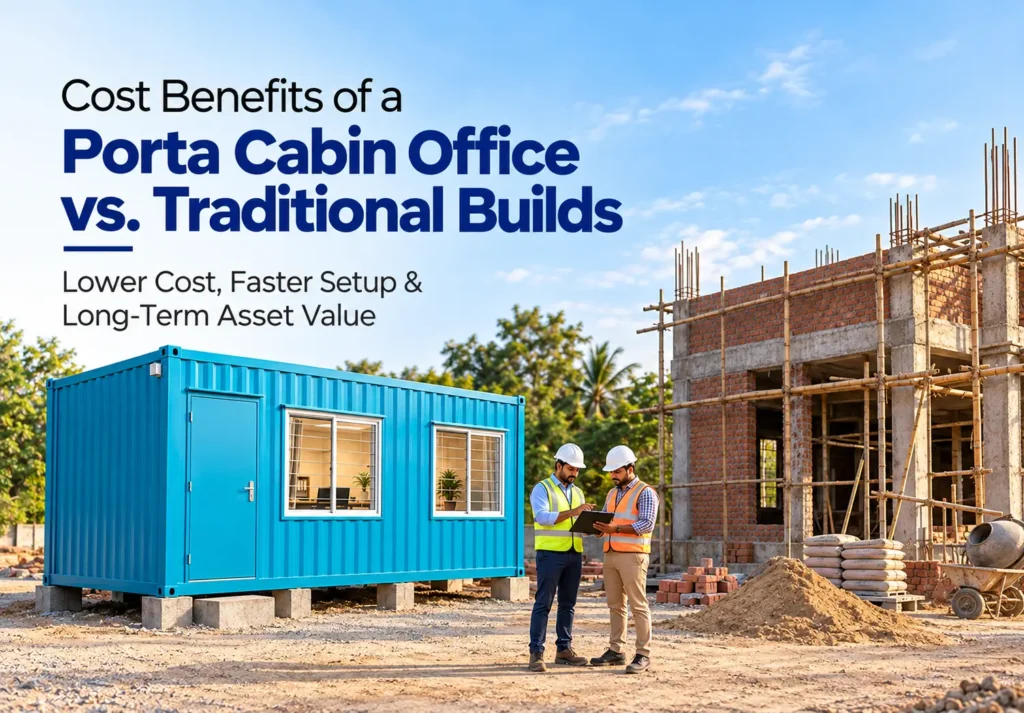
5. Cost: Is a Portable Office Cabin Actually Cheaper?
This question requires a more thoughtful response.
It is tempting to compare:
Portable cabin price
against
Cost of constructing a brick-and-mortar office
and declare one cheaper.
But the better comparison is
Total Cost of Ownership
For a traditional temporary office, you may spend money on:
- Construction
- Labour
- Materials
- Site preparation
- Electrical work
- Plumbing
- Finishing
- Repairs
- Demolition
- Waste disposal
For a portable office, costs may include:
- Cabin manufacturing
- Transportation
- Installation
- Foundation/support preparation where required
- Interior fit-out
- Utilities
The final cost depends on size, specification, location, transport, installation, and project duration.
Therefore, a portable office should not automatically be marketed as “always cheaper.”
Instead, its economic advantage often comes from a combination of factors:
Lower site construction activity + faster deployment + reuse + reduced demolition + better flexibility.
Winner: Depends on the project, but portable cabins can have strong lifecycle economics.
6. Comfort and Insulation
A site office needs to be more than four walls and a roof.
Site teams may spend 8–10 hours a day inside the workspace.
Temperature, noise, ventilation, and overall comfort, therefore, matter.
Modern portable office systems can incorporate insulated wall and roof panels, glazing, electrical systems, air-conditioning provisions, and other features intended to make the space suitable for regular office use. (Portable Office Cabin)
The exact thermal and acoustic performance depends on the panel type, insulation thickness, openings, ventilation, and installation quality.
For projects operating in hot and humid climates, specifying the right insulation system is particularly important.
Winner: Portable Office Cabin—if properly specified.
7. Customization
One misconception is that portable means “one standard box.”
Modern modular systems can be configured according to the project.
For example, a developer might require the following:
Option A
One open office for 4–6 people.
Option B
Project manager’s office + engineer’s room.
Option C
Office + meeting room + pantry.
Option D
Reception + meeting room + multiple workstations.
Option E
Office + storage + toilet.
Portable office cabins can be designed with different internal layouts, partitions, windows, electrical points, storage requirements, and finishes.
Some prefab site-office systems also support meeting room, storage, pantry, and toilet integration. (Portable Office Cabin)
Winner: Tie
Both systems can be customized, although portable systems can offer that customization through a more standardized/modular fabrication process.
8. Quality Control
With conventional construction, much of the work happens outdoors and depends on site conditions and workmanship.
Portable cabins shift a significant portion of fabrication to a controlled manufacturing environment.
Such methods can help with:
- Consistency
- Dimensional accuracy
- Material control
- Fabrication quality
- Reduced weather exposure during manufacturing
However, factory fabrication does not automatically guarantee quality.
The buyer should still check:
- Structural specifications
- Steel grade
- Panel specification
- Insulation
- Flooring
- Electrical system
- Waterproofing
- Hardware
- Installation quality
Winner: Portable Office Cabin—provided the manufacturer follows proper quality controls.
9. Weather and Site Conditions
A traditional temporary office constructed on-site can be affected by:
- Rain
- Heat
- Dust
- Construction delays
- Material availability
- Labour availability
Prefabricated components can be manufactured before they arrive at the site, reducing some of the dependency on on-site construction conditions. (SEAS Homes)
However, the completed cabin still needs to be properly installed and weather-sealed.
A good portable office should be specified for the site’s
- Climate
- Rainfall
- Wind exposure
- Temperature
- Ground conditions
- Drainage
Winner: Portable Office Cabin—when properly designed and installed.
10. What Happens When the Project Ends?
This is where the difference becomes particularly interesting.
Imagine a construction project that lasts 24 months.
At the end:
Traditional Office
The company may need to demolish it.
That means:
Demolition + Labour + Waste + Disposal
Portable Office
It may be possible to dismantle and relocate the cabin.
That means:
Dismantle → Transport → Reinstall
Not every portable cabin is equally easy to relocate, and transport/access costs still apply.
But when reuse is practical, the residual value of the structure becomes an important part of the calculation.
11. Professional Appearance
Your site office isn’t just a workspace.
It can also be the first physical impression your project gives to the following:
- Clients
- Investors
- Consultants
- Architects
- Landowners
- Buyers
- Government officials
- Business partners
A basic temporary shed can communicate one thing.
A well-designed, branded site office can communicate something very different.
Modern portable cabins can incorporate the following:
- Glass windows
- Professional doors
- Clean exterior finishes
- Interior partitions
- Lighting
- Air conditioning
- Branding
- Reception areas
- Meeting rooms
This makes them particularly useful for real estate developers who want their project site to look organized and professional from day one.
Winner: Portable Office Cabin
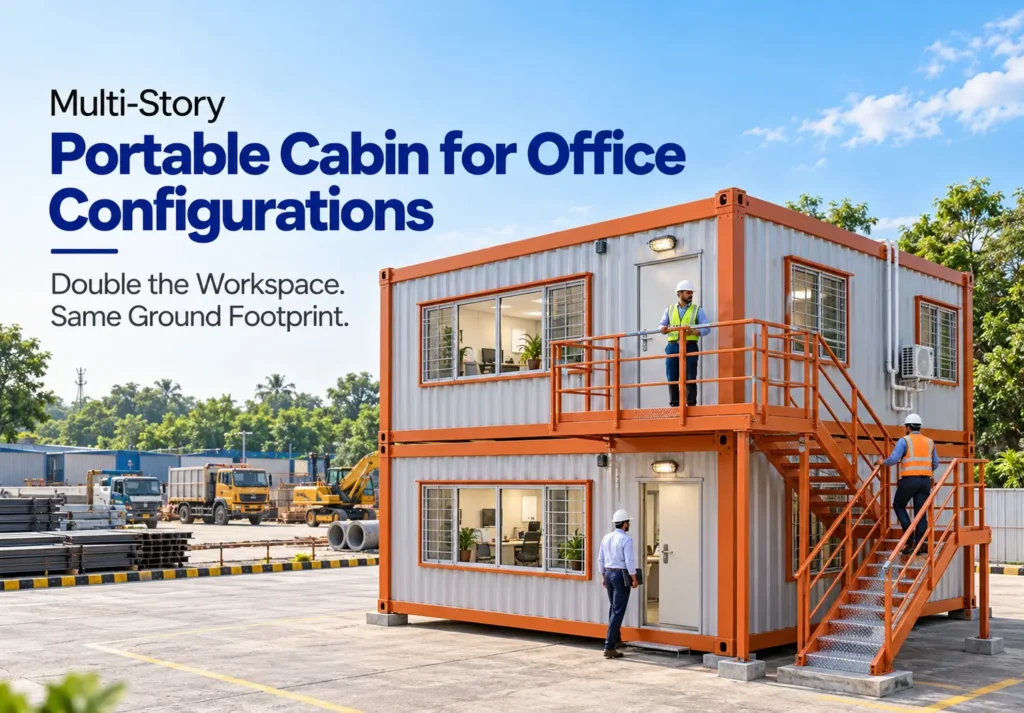
12. Expansion and Changing Requirements
Construction projects evolve.
A project may start with:
4 people
and later require:
10 people.
Or a developer may initially need only a project office but later require the following:
- Sales office
- Customer meeting room
- Additional storage
- Staff area
- Pantry
A modular approach can make it easier to add or reconfigure space, depending on the system.
Traditional construction can also be expanded – but it generally requires another round of construction activity.
Winner: Portable Office Cabin
13. Material Waste
Conventional construction involves cutting, mixing, transporting, and handling materials on site.
Such practices can generate:
- Brick waste
- Cement waste
- Sand waste
- Packaging waste
- Cutting waste
Prefabrication can shift much of the production to a controlled environment where material usage can be planned more systematically.
That does not mean portable construction creates zero waste.
It means the opportunity for controlled fabrication and reduced site waste can be greater.
Winner: Portable Office Cabin
14. Project Timeline
Let’s imagine a developer starts a new project.
They need an office before:
- Contractor coordination
- Procurement
- Site meetings
- Drawing reviews
- Client meetings
- Daily project management
A traditional office needs to be constructed first.
A portable office can potentially be fabricated in parallel with other pre-construction activities.
This is one of the fundamental advantages of prefabrication:
The building and site preparation can become more parallel processes, rather than one waiting for the other.
Prefabricated construction is widely associated with shortening on-site construction activity because components are produced off-site before assembly. (SEAS Homes)
Portable Office Cabin vs Traditional Site Office: Detailed Scorecard
| Factor | Portable Office Cabin | Traditional Site Office |
|---|---|---|
| Speed | ⭐⭐⭐⭐⭐ | ⭐⭐⭐ |
| Relocation | ⭐⭐⭐⭐⭐ | ⭐ |
| Reuse | ⭐⭐⭐⭐⭐ | ⭐ |
| Site disruption | ⭐⭐⭐⭐⭐ | ⭐⭐ |
| Customization | ⭐⭐⭐⭐ | ⭐⭐⭐⭐⭐ |
| Long-term fixed use | ⭐⭐⭐⭐ | ⭐⭐⭐⭐⭐ |
| Professional appearance | ⭐⭐⭐⭐ | ⭐⭐⭐⭐ |
| Construction waste | ⭐⭐⭐⭐ | ⭐⭐⭐ |
| Initial flexibility | ⭐⭐⭐⭐⭐ | ⭐⭐⭐ |
| Project-to-project use | ⭐⭐⭐⭐⭐ | ⭐ |
| Permanent building potential | ⭐⭐⭐ | ⭐⭐⭐⭐⭐ |
This isn’t a universal technical rating; it is a practical comparison based on the characteristics of each approach.
When Is a Portable Office Cabin the Better Choice?
A portable office cabin can be particularly suitable when:
1. The Project Is Temporary
If the office is required only during construction, building a permanent structure may not be the most practical approach.
2. The Project Is Mobile
Infrastructure projects can move across different work fronts.
3. You Have Multiple Projects
Contractors can potentially reuse the same office across projects.
4. You Need an Office Quickly
When project schedules are tight, faster deployment can be valuable.
5. The Site Has Limited Space
A compact, purpose-designed cabin can provide a dedicated workspace without extensive site construction.
6. You Want a Professional Client-Facing Space
Developers can create branded project offices for customer meetings and sales activities.
7. You Expect Changing Requirements
Modular solutions can provide greater flexibility.
When is a traditional site office the better choice?
Portable cabins aren’t the right answer for every situation.
A conventional building may make more sense when:
The Office Will Become Permanent
If the structure is ultimately intended to remain as a permanent building, conventional construction may be appropriate.
The Project Has Significant Available Time
If the project timeline allows extensive site construction, speed may be less important.
You Need a Highly Integrated Permanent Building
Some projects require structural integration with the main development.
The Building Requires Specialized Architectural Treatment
A permanent office building may offer greater freedom for highly complex architectural forms.
Local Regulations or Site Conditions Require It
The appropriate solution must always comply with applicable building, safety, and site requirements.
The right choice is therefore not about declaring one technology universally superior.
It is about matching the building system to the project’s actual requirement.
Portable Office Cabin vs. Container Office: Are They the Same?
Not necessarily.
The terms are sometimes used interchangeably, but there can be important differences.
A portable office cabin may be a purpose-built modular structure using a steel frame and insulated wall/roof panels.
A container office may be based on a shipping-container form or container shell.
Both can be useful, but their
- Dimensions
- Structural systems
- Insulation
- Internal height
- Customization
- Transportation requirements
- Cost
- Installation methods
can differ.
So don’t choose based only on the word “portable.”
Ask:
What construction system is being offered?
What Should You Check Before Buying a Portable Office Cabin?
If you’re considering a portable site office, don’t compare suppliers only on price.
Check these 12 things.
1. Structural System
Ask about:
- Frame material
- Steel specification
- Structural design
- Corrosion protection
2. Insulation
Ask:
- What insulation is being used?
- What is its thickness?
- Is it suitable for your climate?
3. Flooring
Check:
- Base material
- Flooring finish
- Load capacity
- Moisture resistance
4. Roofing
Understand:
- Roof material
- Insulation
- Waterproofing
- Drainage
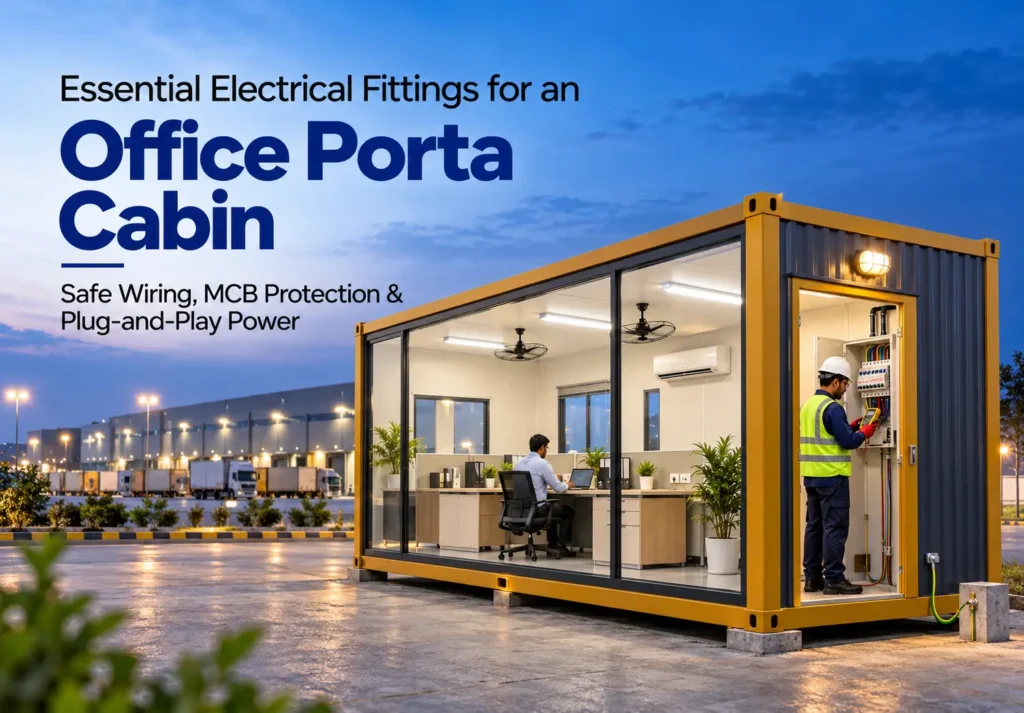
5. Electrical System
Check:
- Wiring
- MCB/DB
- Switches
- Sockets
- Lighting
- AC provision
6. Doors and Windows
Look at:
- Material
- Glass specification
- Locks
- Weather sealing
7. Transport
Ask:
How will the cabin reach my site?
Transport depends on dimensions, access roads, and location.
8. Installation
Clarify:
- Who installs it?
- What site preparation is required?
- What equipment is needed?
9. Relocation
If mobility is important, ask:
Can this exact unit be dismantled and relocated?
10. Warranty
Understand what is covered and for how long.
11. Customization
Ask what can be customized:
- Layout
- Size
- Windows
- Doors
- Electrical
- Interiors
- Branding
12. After-Sales Support
A reliable supplier should be able to support you after installation.
How Much Does a Portable Site Office Cost?
There is no single price for a portable office cabin.
The final cost can depend on the following:
- Size
- Structure
- Insulation
- Flooring
- Doors/windows
- Electrical specification
- Interior finish
- Air-conditioning provision
- Plumbing
- Furniture
- Branding
- Transport
- Installation
- Location
For example, a compact supervisor cabin will have a completely unique budget from a multi-room project office with a meeting room, pantry, and premium finishes.
Therefore, instead of asking only
“What is your price per sq ft?”
Ask for a complete specification-based quotation.
That makes supplier comparison much more meaningful.
Is a Portable Office Cabin Suitable for Kolkata?
Yes, portable cabins can be particularly practical for construction projects where quick deployment, flexibility, and weather-appropriate design are important.
But the specification matters.
For Kolkata and surrounding areas, consider:
- Insulation
- Rainwater protection
- Roof drainage
- Ventilation
- Corrosion protection
- Electrical safety
- Moisture-resistant materials
- Air-conditioning provision
Kolkata’s hot, humid summers and monsoon conditions mean that a cabin should be designed as a functional workspace, not simply an enclosed metal structure.
PortaSpaze’s own Kolkata-focused content positions modern portable cabins as applications for construction sites and other use cases, emphasizing the move beyond the traditional “tin box” concept. (PortaSpaze)
Why PortaSpaze Is Different
At PortaSpaze, the idea is simple:
A portable cabin should be more than a temporary box.
It should be a properly designed space that delivers the following:
- Functionality
- Comfort
- Mobility
- Durability
- Better aesthetics
- Efficient use of space
For construction projects, that can mean creating a site office where teams can actually work comfortably, meet clients, review drawings, and coordinate the project.
And because the cabin is designed as a modular/portable solution, it can potentially move with the business rather than becoming another structure that has to be demolished when the project ends.
The Bigger Shift: From “Temporary Cabin” to “Flexible Infrastructure”
The construction industry is changing.
Projects are becoming more dynamic.
Teams move between locations.
Development timelines are tighter.
Businesses want infrastructure that can adapt.
This is where portable construction becomes interesting.
Instead of thinking:
“We need a temporary office.”
Think:
“We need a workspace that can adapt to our project.”
That change in mindset is important.
A portable office cabin can become the following:
Project Office → Meeting Room → Sales Office → Relocatable Office → Next Project
That’s a completely unique proposition from building a temporary structure and demolishing it later.
Frequently Asked Questions
Are portable office cabins better than traditional site offices?
For projects where speed, mobility, and reuse are important, portable office cabins can be a strong alternative to conventional site offices. Traditional construction can be more appropriate when a permanent, fixed building is required.
How quickly can a portable office cabin be installed?
Installation time varies according to the cabin size, construction system, site preparation, and customization. Prefabrication can significantly reduce the amount of construction work required on-site compared with building an office conventionally. (SEAS Homes)
Can a portable office cabin be moved?
Many portable and modular office systems are designed to be relocated, although the actual ease and cost of relocation depend on the design, dimensions, access, and transport requirements. (Portable Office Cabin)
Can portable office cabins be customized?
Yes. Depending on the manufacturer, cabins can be customized in terms of size, layout, partitions, windows, electrical systems, flooring, insulation, and other features.
Are portable office cabins suitable for long-term use?
Yes, a properly designed and maintained portable office can be used for extended periods. The appropriate specification should be selected based on the project’s duration, climate, usage, and relocation requirements.
Are portable cabins insulated?
Many modern portable office cabins use insulated wall and roof systems. The type and thickness of insulation vary by manufacturer and model, so specifications should be checked before purchase. (Portable Office Cabin)
Are portable cabins suitable for Kolkata’s weather?
They can be, provided they are appropriately designed for local conditions, with suitable insulation, waterproofing, drainage, ventilation, and corrosion protection.
Can a portable office cabin include a meeting room?
Yes. Portable offices can be configured with internal partitions to create meeting rooms, manager cabins, workstations, and other spaces.
Can a portable office cabin be reused on another construction project?
Many modular systems are designed for relocation and reuse, making them potentially useful for contractors and developers managing multiple projects. (SAMAN POS India Private Limited)
Final Verdict: Portable Office Cabin or Traditional Site Office?
There is no single answer for every construction project.
But if your priority is
Speed → Portable
Mobility → Portable
Reuse → Portable
Minimal site construction → Portable
Changing project requirements → Portable
Professional temporary workspace → Portable
If your priority is:
Permanent fixed structure → Traditional construction may make more sense
Highly integrated permanent building → Traditional construction may be preferable
Complex permanent architecture → Traditional construction may offer greater flexibility
However, for most temporary or relocatable construction-site office needs, portable office cabins provide a strong mix of speed, flexibility, reusability, and functionality.
The real question isn’t
“Is a portable cabin cheaper than a traditional office?”
It’s:
“Why invest in building a temporary office that you may have to demolish when you can create a workspace designed to move with your project?”
That’s the real value of portable infrastructure.
Need a professional site office for your next construction project?
Explore modern, customizable portable office solutions with PortaSpaze.
Build it. Use it. Move it. Reuse it.