The CapEx vs. OpEx Dilemma in Modern Site Infrastructure
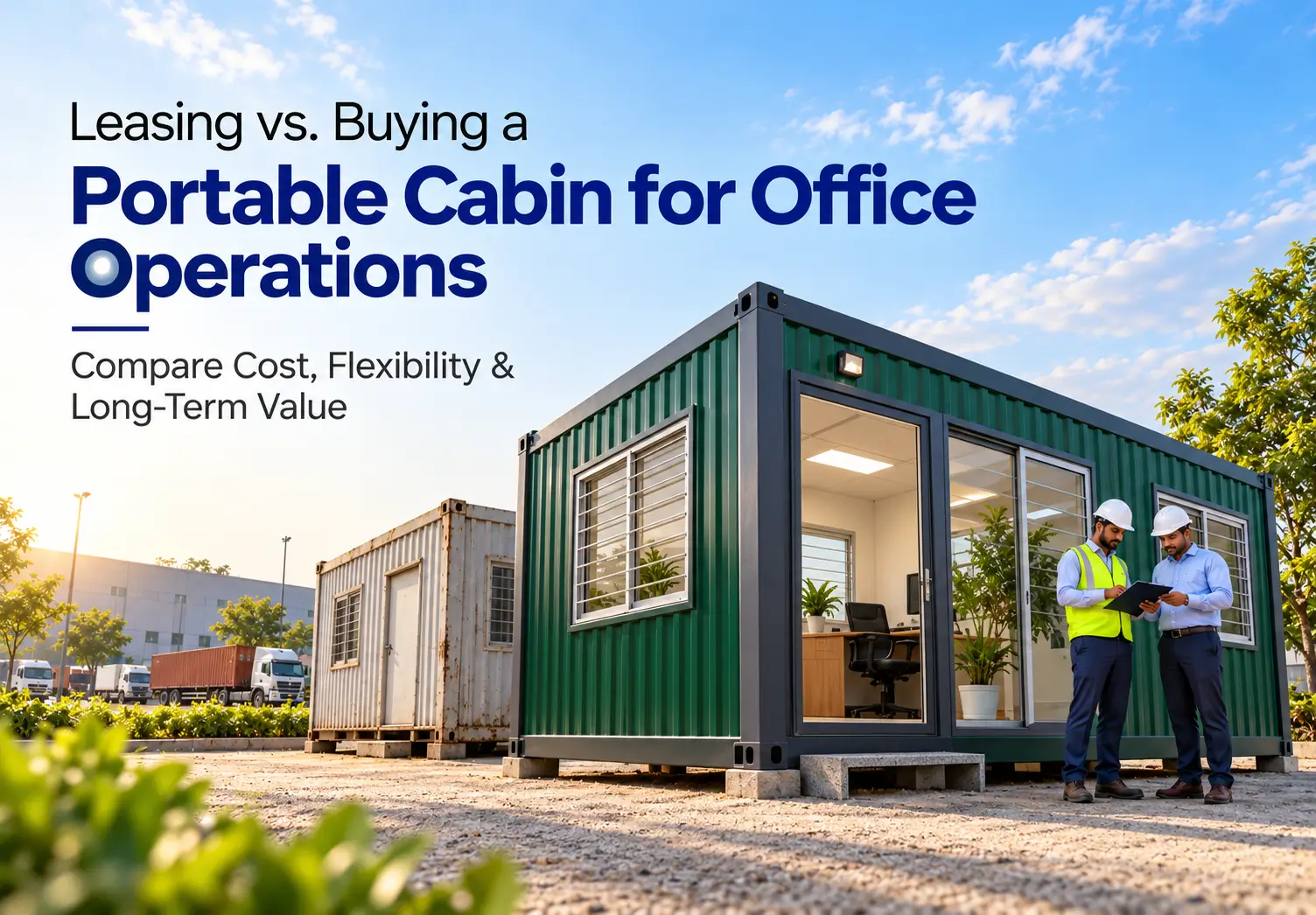
When launching a high-value civil infrastructure contract, an industrial plant expansion in Haldia, or a commercial logistics hub along the NH6 Corridor, B2B procurement teams and project directors in Kolkata face an immediate financial crossroads. Every active project site requires a secure, climate-controlled administrative command center to house site engineers, project managers, billing teams, and critical IT hardware. Once you rule out the slow, wasteful practice of building a temporary brick-and-mortar structure, the next critical procurement decision emerges: should your company lease or buy a portable cabin for office operations?
On the surface, short-term rental agreements can appear attractive to cash-conscious contractors looking to minimize upfront capital expenditure (CapEx). However, across Eastern India’s booming infrastructure, mining, and manufacturing sectors, project lifecycles frequently extend beyond initial estimates, and thriving engineering firms rarely stop at a single contract. When recurring monthly rental invoices, two-way crane logistics charges, security deposits, and heavy end-of-lease damage penalties are audited over a 12-to-36-month horizon, leasing often exposes companies to severe financial leakage.
Conversely, outright acquisition of a factory-engineered Modular Office Cabin converts a recurring monthly operational expense (OpEx) into a high-yield, depreciable corporate asset that serves your organization across decades of consecutive projects. This comprehensive financial and technical guide breaks down the exact break-even math, accounting mechanics, customization limitations, and structural engineering factors that procurement leaders must evaluate when deciding between leasing and buying a modular workspace.
Core Topic Deep-Dive: Financial and Operational Analysis of Leasing vs. Buying a Portable Cabin for Office Use
To make an informed procurement decision, project directors and Chief Financial Officers (CFOs) must evaluate five core financial and operational dimensions: the cumulative break-even timeline, corporate tax and depreciation treatment, customization freedoms, hidden contractual liabilities in rental agreements, and fleet logistics management.
1. The Break-Even Timeline: 12-Month, 24-Month, and 36-Month Financial Modeling
In the Eastern Indian modular equipment market, monthly rental rates for a standard 20 ft x 10 ft workspace are typically priced so that the rental company recovers the full manufacturing cost of the cabin within 10 to 14 months. When you lease a Readymade Cabin, your upfront outlay is not just the first month’s rent; rental vendors typically mandate a refundable security deposit equivalent to 3 to 6 months of rent, plus non-refundable upfront charges for crane loading at their yard, flatbed transport to your site, and return transport at the end of the contract.
Consider the financial trajectory across standard B2B project durations:
- Short-Term Deployments (1 to 6 Months): If your organization is managing a brief, one-off event, a seasonal disaster-relief camp, or a 90-day pipeline repair shutdown with zero intention of bidding on future infrastructure contracts in the region, leasing a portable cabin for office use can preserve short-term working capital.
- Medium-Term Projects (12 to 18 Months): By Month 12 to Month 14, cumulative monthly lease payments—combined with two-way transportation fees—routinely equal or exceed 100% of the outright purchase price of a brand-new Portable Office Container. Worse still, in a lease scenario, construction delays caused by monsoons or land-acquisition bottlenecks penalize your budget directly; every month of project extension triggers another rental invoice for an asset you will never own.
- Long-Term & Multi-Site Operations (24 Months to 15+ Years): By Month 24, a company leasing its site office has effectively paid for the cabin twice over while holding zero equity. A contractor who purchases the cabin outright reaches full capital recovery in just over a year and enjoys zero monthly housing rent for the remainder of the current project—and across the next five to ten projects over the cabin’s 15-to-20+ year structural lifespan.
2. CapEx vs. OpEx, Tax Depreciation, and Residual Resale Equity
From a corporate balance-sheet perspective, leasing is classified strictly as an Operational Expenditure (OpEx). While monthly lease payments can be deducted as an operating expense during the fiscal year they are incurred, the cash leaves your company permanently, building zero net worth on your balance sheet.
When you purchase a Modular Office Cabin, the outlay is recorded as a Capital Expenditure (CapEx) under movable plant, machinery, or temporary site structures. Unlike permanent brick-and-mortar real estate—which suffers from slow depreciation schedules and zero mobility—a movable steel cabin qualifies for accelerated corporate tax depreciation benefits under Indian accounting standards. This allows businesses to write down the asset value rapidly while retaining physical ownership.
Furthermore, heavy-duty Mild Steel (MS) modular cabins hold exceptional secondary-market liquidity across industrial hubs like Kolkata, Haldia, Durgapur, and Jamshedpur. Even if a contractor decides to liquidate a purchased cabin after completing a single two-year highway contract, a well-maintained MS unit easily commands 50% to 65% of its original purchase value on the resale market—retroactively cutting the net cost of ownership to less than half of what a lease would have cost.
3. Customization Freedom vs. Standardized Rental Fleet Constraints
Rental companies maximize their fleet utilization by keeping their inventory as generic as possible. When you lease a cabin, you are typically handed a bare-bones, pre-used 20 ft x 10 ft open box that has already endured multiple previous tenants. Rental contracts strictly prohibit structural modifications: you cannot cut additional window openings, weld equipment brackets to the walls, install custom acoustic partitions, or integrate attached executive washrooms and pantries without forfeiting your security deposit.
Purchasing a portable cabin for office operations directly from a manufacturer like PortaSpaze unlocks 100% architectural and functional customization. Your engineering team dictates the exact footprint—from compact 10 ft x 10 ft security and supervisor booths up to expansive 30 ft x 10 ft and 40 ft x 10 ft corporate command centers. You can specify custom split-room partitions separating junior engineering bays from soundproofed project manager suites, choose between 9 mm Particle Board or sleek 4 mm Aluminium Composite Panel (ACP) interiors, position 6A/16A workstation sockets and LAN conduits to match your exact desk layout, and have the exterior painted in your company’s proprietary corporate fleet colors.
4. Eliminating “Wear-and-Tear” Disputes and End-of-Lease Penalties
Active industrial and construction sites along the NH6 Corridor or inside mining zones are rugged environments. Muddy safety boots, heavy blueprint plotters, fluctuating site generator voltages, and accidental impacts from site equipment are everyday realities. When returning a leased cabin, procurement teams frequently face aggressive back-charges from rental vendors for scuffed vinyl flooring, dented exterior panels, pinholes in interior walls, or degraded paintwork. These penalty deductions regularly wipe out a large portion of the initial security deposit.
When you own your Portable Office Container, you answer to no external landlord. Built with industrial-grade 1.2 mm corrugated MS sheets and 18 mm Cement Fiber Board floors, your owned cabin is designed to absorb the rigors of heavy industrial deployment. Minor cosmetic scuffs do not trigger third-party financial penalties, and routine touch-ups can be handled in-house by your own site maintenance crew at negligible cost.
5. Fleet Readiness and Multi-Site Redeployment Agility
When a major tender is awarded in Eastern India, mobilization speed determines project profitability. Relying on rental fleets during peak construction seasons (post-monsoon October through May) exposes contractors to inventory shortages, inflated peak-season rental tariffs, and delayed delivery schedules as you wait for previous lessees to return units.
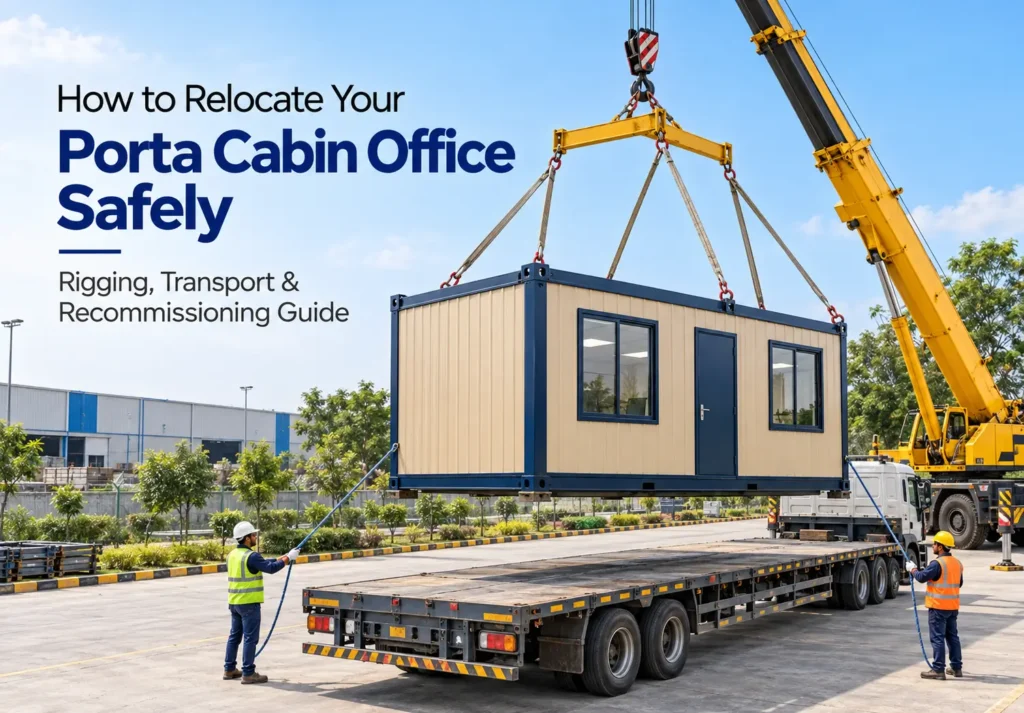
Maintaining an owned fleet of Readymade Cabin units gives your organization autonomous mobilization power. The moment a contract finishes in Dankuni and a new tender begins in Haldia or Bhubaneswar, your logistics team simply disconnects the external power plug, hoists the cabin onto a flatbed trailer via its reinforced top corner lifting points, and deploys your fully furnished, pre-wired office at the new site within 24 hours.
Key Features & Materials: Why Buying a PortaSpaze Cabin Delivers Decades of ROI
The financial logic of buying over leasing only holds true if the cabin you purchase is engineered to survive 15 to 20+ years of repeated crane hoisting, highway transit, and extreme tropical weather. Cheap, lightly framed cabins built with thin riveted sheets will twist and rust within two seasons. At PortaSpaze, every portable cabin for office deployment is manufactured in Kolkata using heavy-gauge metallurgical specifications that guarantee multi-decade asset longevity:
- Heavy-Gauge Square Hollow Section (SHS) Structural Skeleton: To withstand the dynamic stresses of repeated crane lifting and flatbed transport across multiple projects, our base frames and corner pillars are over-engineered. Cabins from 10 ft x 10 ft up to 20 ft x 10 ft are built on a rigid 60 mm x 60 mm SHS base frame supported by 72 mm x 72 mm structural corner posts. For larger 30 ft x 10 ft and 40 ft x 10 ft units, we upgrade the skeleton to a massive 72 mm x 72 mm SHS base frame and 90 mm x 90 mm corner posts, unified by a 50 mm x 50 mm SHS top roof frame.
- Continuously Welded 1.2 mm Corrugated Mild Steel (MS) Shell: Both the exterior walls and roof are fabricated from 1.2 mm thick corrugated Mild Steel sheets that are continuously seam-welded rather than riveted or bolted. This creates a monolithic, weather-tight structural box that resists torsion during rigging and prevents water seepage during cyclonic monsoons.
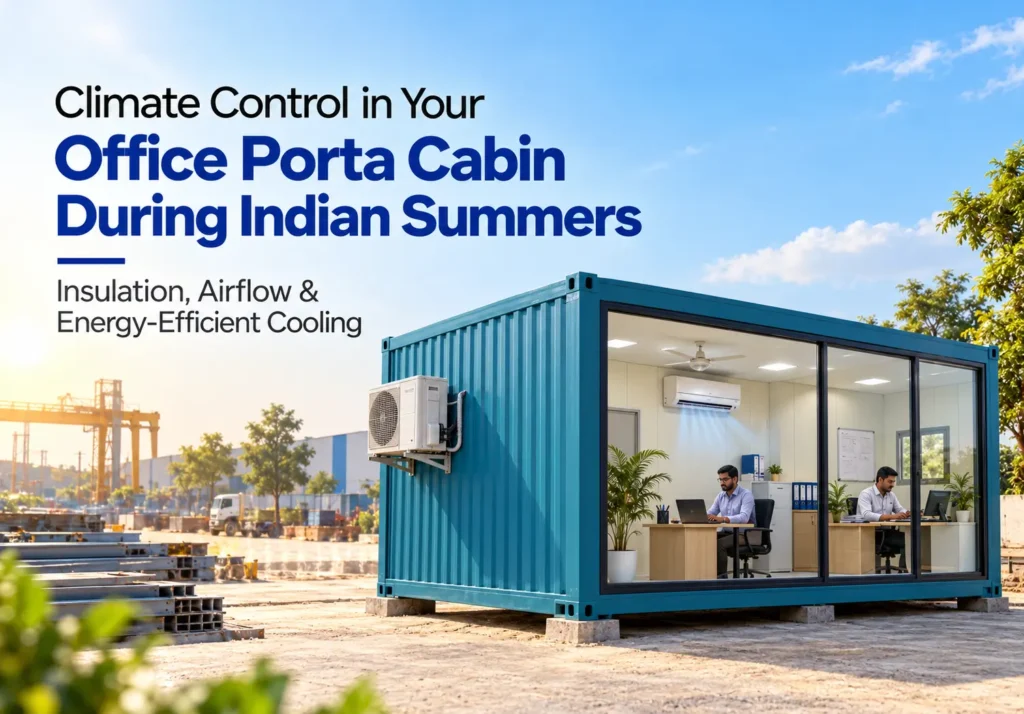
- High-Density 25 mm Glasswool & Custom PUF Thermal Insulation: Every cabin is lined with a dense 25 mm thick Glasswool thermal and acoustic insulation core (with custom options for 50 mm to 80 mm PUF or EPS sandwich panels). This barrier blocks solar heat gain during 42°C Indian summers, dampens deafening exterior machinery noise, and cuts air conditioning electricity consumption by up to 30%.
- Customizable ACP or Particle Board Interior Cladding: Buyers can tailor the internal wall and ceiling finish to their exact budget and corporate aesthetic, choosing between durable 9 mm Particle Board or premium 4 mm Aluminium Composite Panels (ACP). Both finishes provide a clean, bright, corporate-grade workspace that requires zero plastering or periodic whitewashing.
- Rot-Proof 18 mm Cement Fiber Board Flooring System: Instead of standard plywood that delaminates or rots in humid coastal climates, our floor assembly utilizes a heavy-duty 18 mm Cement Fiber Board base finished with a 1 mm thick anti-skid, antistatic PVC Vinyl mat (or optional vitrified tiles/industrial checker plates). This system is 100% impervious to termites, moisture, and heavy foot traffic.
- Dual-Layer Anti-Corrosive Coating & Protected Glazing: Every square inch of structural steel is mechanically cleaned and treated with an industrial Red Oxide anti-rust primer, followed by two topcoats of weather-grade Synthetic Enamel paint (Asian, Berger, or Nerolac) in standard Feroza Blue or custom corporate branding shades. Entryways feature a rugged 6 ft x 3 ft corrugated MS door with rain guards and ISI-marked stainless steel hardware, paired with 3 ft x 3 ft aluminium sliding windows protected by integrated steel safety grills and exterior rain rail guards.
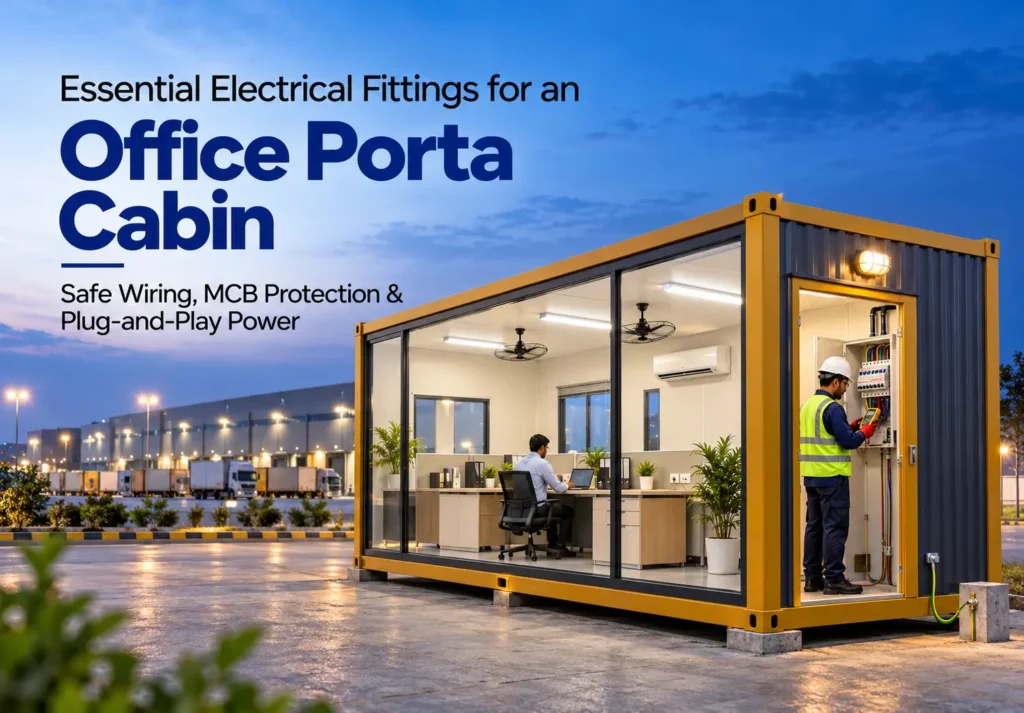
- Factory-Fitted ISI Concealed Electrification: Each unit arrives 100% plug-and-play, pre-wired with concealed fire-retardant copper cables from certified brands (Finolex, Polycab, Reo, or Gloster). Standard electrical fit-outs include 220–240V MCB distribution boards, bright LED tube lights, high-speed ceiling rotary cage fans, 6A/16A workstation switch sockets, dedicated high-load AC power provisions, and an external weatherproof bulkhead light.
Strategic Comparisons: Owned Modular Office Cabins vs. Leased Units & Civil Builds
When presenting an infrastructure procurement proposal to senior management, comparing an owned Modular Office Cabin against both short-term rental cabins and traditional brick-and-mortar construction highlights why purchasing modular assets is the gold standard for B2B operations:
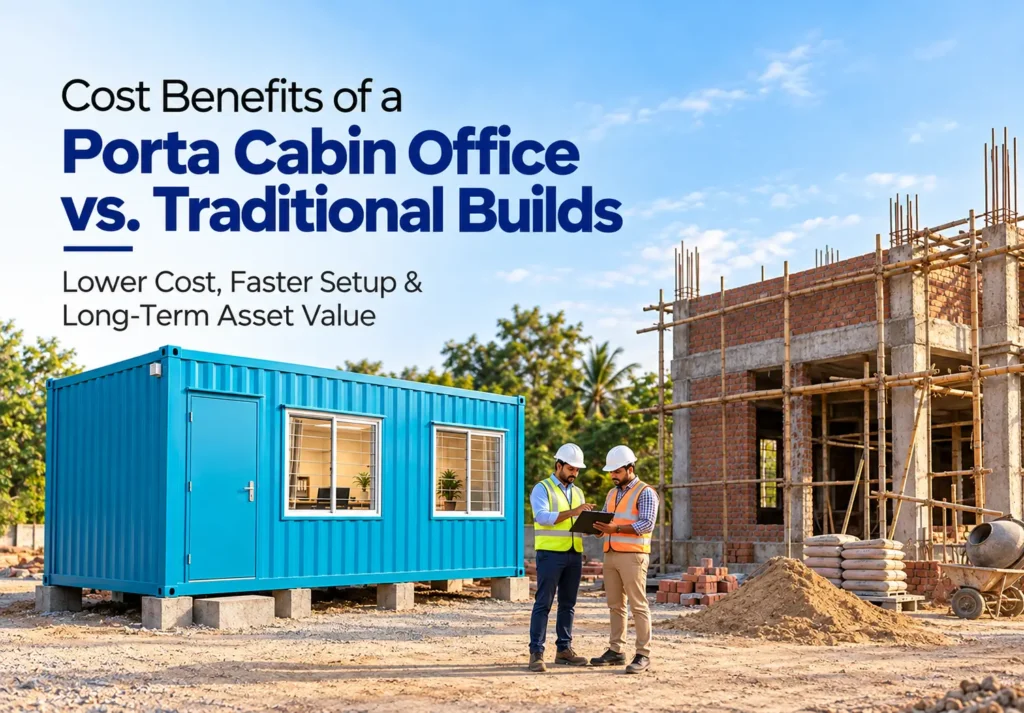
- Total Cost of Ownership (TCO) Over 3 Years: Buying a portable cabin for office use requires a single, predictable upfront payment and yields zero monthly rent thereafter, saving 40% to 60% over a 36-month period compared to leasing, and saving 35% to 50% compared to building and demolishing brick-and-mortar structures across two sites.
- Deployment Speed & Operational Readiness: Both owned and leased modular cabins deploy in days rather than the 3 to 6 months required for traditional civil masonry. However, purchasing a new factory-built Readymade Cabin guarantees a pristine, odor-free, newly wired environment, whereas leased units often arrive with worn interiors, outdated wiring, and cosmetic damage from prior lessees.
- Asset Equity & Balance Sheet Value: An owned Portable Office Container remains a tangible, liquid asset on your company’s books that can be depreciated for tax advantages, reused across 5 to 10+ consecutive projects, or resold for 50%–65% of its initial value. Both rental leases and temporary brick-and-mortar buildings leave your company with 0% equity at project completion.
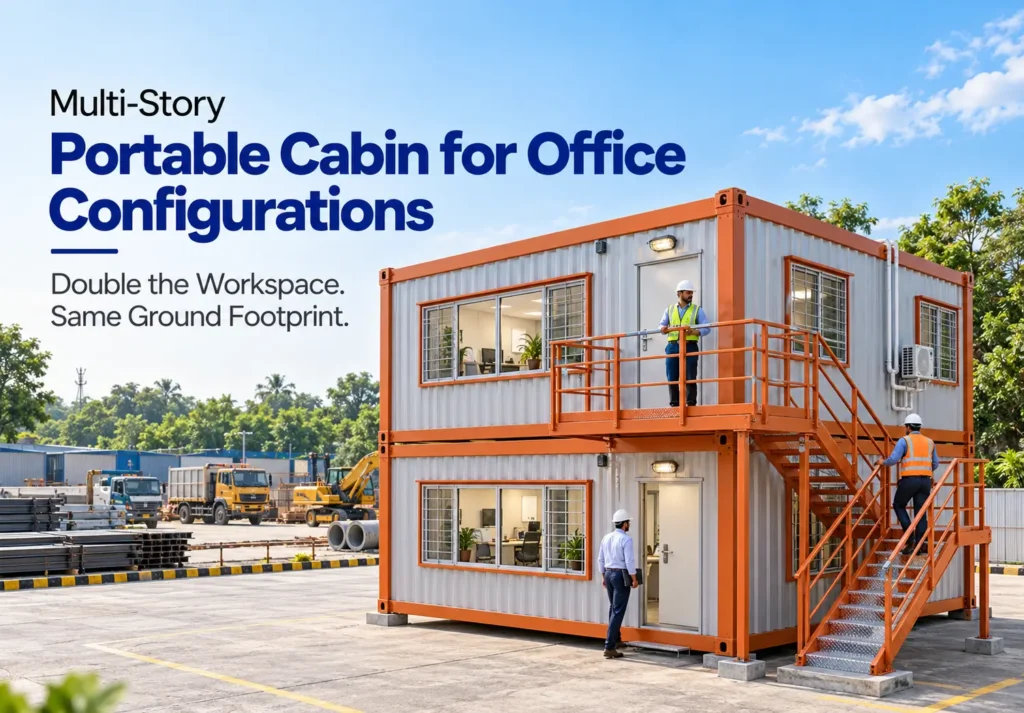
- Brand Image & Layout Tailoring: Owning allows complete bespoke engineering—including multi-module horizontal linking, G+1 vertical stacking with external staircases, glass facades, and custom corporate paint schemes. Leased cabins lock you into rigid, unalterable box layouts, while civil builds cannot be reconfigured or moved once mortar sets.
Frequently Asked Questions (FAQ)
At what project duration does buying a portable cabin for office use become cheaper than leasing?
In Eastern India’s commercial market, the financial break-even point between leasing and buying a portable cabin for office operations typically occurs between 10 and 14 months. Once you factor in upfront rental security deposits, two-way crane and transport charges, and end-of-lease refurbishment fees, any project lasting a year or longer—or any business planning to execute multiple sequential projects—will achieve substantially lower Total Cost of Ownership by purchasing the cabin outright.
What standard sizes can we buy if we choose a Portable Office Container from PortaSpaze?
We manufacture a comprehensive range of standard footprints, all featuring a spacious 8.5 ft internal clear height: 10 ft x 10 ft and 15 ft x 10 ft (ideal for security check-posts or single-supervisor cabins), 20 ft x 10 ft (our most popular executive and engineering team cabin), and expansive 30 ft x 10 ft and 40 ft x 10 ft units (engineered with upgraded 72×72 mm base frames and 90×90 mm corner posts for large project headquarters and conference rooms). We also fabricate bespoke dimensions and multi-module complexes on demand.
How many times can an owned Modular Office Cabin be relocated across different sites?
Because PortaSpaze engineers every Modular Office Cabin with heavy-gauge Square Hollow Section (SHS) steel skeletons, continuously welded 1.2 mm corrugated MS shells, and reinforced top rigging hooks, our cabins can be safely hoisted by crane and transported via flatbed truck dozens of times over their 15-to-20+ year lifespan without suffering frame distortion, door misalignment, or roof leaks.
Does buying a Readymade Cabin require permanent land ownership or municipal building permits?
No. A Readymade Cabin is legally and structurally classified as a temporary, movable piece of equipment rather than permanent civil real estate. Therefore, you can deploy a purchased cabin on leased project land, highway right-of-way zones, or port authority plots in Kolkata and Haldia without forfeiting the asset when the land lease expires, and typically without requiring permanent municipal building plan approvals.
Why Choose PortaSpaze to Build Your Corporate Modular Fleet in Eastern India
Stop draining your project budget into endless monthly rental invoices for worn-out cabins or sinking capital into brick-and-mortar site offices that will eventually be bulldozed. As Eastern India’s premier modular construction manufacturer headquartered in Kolkata, PortaSpaze empowers civil contractors, industrial enterprises, and infrastructure developers across the NH6 Corridor, Haldia, Durgapur, Dankuni, Odisha, and Jharkhand to build permanent operational equity through heavy-duty modular assets.
When you invest in a portable cabin for office operations from PortaSpaze, you receive factory-direct manufacturer pricing with zero middleman markups. Every cabin is precision-welded from certified structural Mild Steel, treated with dual-layer Red Oxide and Synthetic Enamel weatherproofing, insulated with high-density Glasswool or PUF cores, and pre-wired with ISI-marked electrical systems for immediate plug-and-play commissioning. Whether you need a single 20 ft x 10 ft engineering office delivered within days or a custom-configured fleet of 40 ft command centers built to your exact corporate blueprints, our engineering team delivers unmatched structural reliability.
Take full financial control of your worksite infrastructure today. Contact the engineering and sales specialists at PortaSpaze to compare sizing configurations, request a detailed technical specification sheet, or secure a transparent, factory-direct quote for your next project in Eastern India.