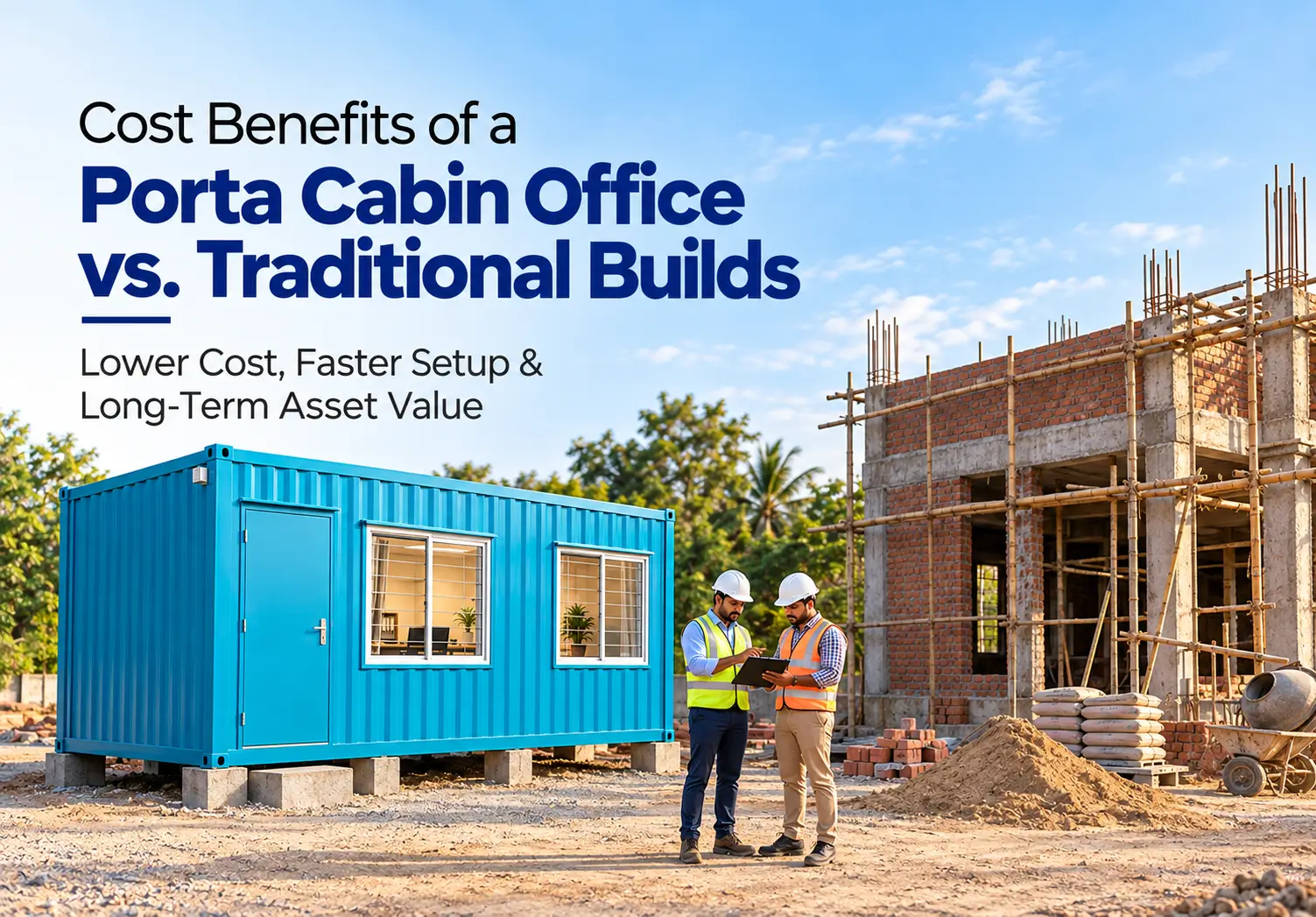
Introduction
In the high-stakes landscape of civil infrastructure, heavy manufacturing, and industrial expansion across Eastern India, capital allocation efficiency dictates project survival. When establishing administrative headquarters or site command hubs along the bustling NH6 Corridor, within the petrochemical zones of Haldia, or across rapidly expanding commercial sectors in Kolkata, procurement teams and project directors face an immediate financial dilemma: commit substantial capital to traditional brick-and-mortar masonry or invest in a modern porta cabin office.
For decades, conventional civil construction was viewed as the default route for on-site administration. However, traditional builds carry severe financial liabilities—unpredictable raw material inflation, protracted labor timelines, complex municipal permitting, and zero asset liquidity once a project concludes. When a highway contract finishes or a temporary logistics hub relocates, a brick-and-mortar site office becomes a sunk cost that must either be abandoned or demolished at additional expense.
Today, forward-thinking engineering contractors and B2B procurement specialists are shifting toward modular prefabrication. Deploying a precision-engineered Modular Office Cabin transforms site infrastructure from a depreciating, immobile expense into a relocatable, high-yield capital asset. This comprehensive financial and technical analysis examines the exact cost benefits, structural engineering advantages, and return on investment (ROI) of choosing a prefabricated workspace over traditional civil construction.
Core Topic Deep-Dive: The Financial Anatomy of a Porta Cabin Office vs. Civil Builds
Evaluating the true cost of site infrastructure requires looking far beyond the initial material invoice. Procurement managers must analyze Total Cost of Ownership (TCO), which encompasses direct capital expenditure (CapEx), operational expenditure (OpEx), opportunity costs tied to deployment timelines, and end-of-project asset recovery. Across every financial metric, a porta cabin office delivers measurable fiscal superiority over conventional masonry.
1. Direct Capital Expenditure (CapEx) and Elimination of Cost Overruns
Traditional civil construction is notoriously vulnerable to budget creep. Building a standard 200 to 400 sq. ft. brick-and-mortar office requires sequential procurement of cement, river sand, aggregates, structural TMT steel, bricks, timber formwork, electrical conduits, plumbing fixtures, and finishing paints. Price volatility in any of these commodities—combined with local supply chain bottlenecks—routinely pushes civil projects 20% to 35% over their initial sanctioned budgets.
In contrast, procuring a Readymade Cabin from an established modular manufacturer operates on a fixed-price, factory-direct procurement model. Because fabrication occurs in a controlled industrial facility in Kolkata, raw Mild Steel (MS) channels, corrugated sheets, and insulation cores are purchased in bulk, shielding the buyer from localized retail price spikes. You receive a single, transparent invoice covering structural framing, thermal insulation, interior paneling, flooring, and factory-tested electrical networks. Overall upfront CapEx for a modular unit is typically 30% to 45% lower per square foot than an equivalent permanent civil structure.
2. Foundation Engineering and Site Preparation Savings
Before a single brick can be laid for a conventional office, civil engineers must execute extensive soil testing, deep trench excavation, reinforced concrete footing pours, and plinth beam curing. In the alluvial, marshy, or coastal soils common across West Bengal, Haldia, and the Gangetic plains, deep foundations are expensive and time-consuming to stabilize.
A Portable Office Container eliminates up to 85% of foundation costs. Engineered around a rigid, self-supporting Square Hollow Section (SHS) steel base frame, a modular cabin distributes structural and live loads evenly across its perimeter. It requires only minimal ground preparation—typically four to six simple concrete pier blocks, a leveled compact gravel bed, or a thin PCC (Plain Cement Concrete) surface pad. This drastically reduces civil groundwork expenses and preserves the natural topography of leased land.
3. Labor Overheads and Site Management Costs
Conventional building demands a rotating roster of specialized on-site labor: excavators, masons, bar-benders, carpenters, plasterers, electricians, painters, and site supervisors. Managing these crews introduces daily wage overheads, accommodation and sanitation liabilities, safety compliance costs, and productivity losses caused by local strikes or inclement weather.
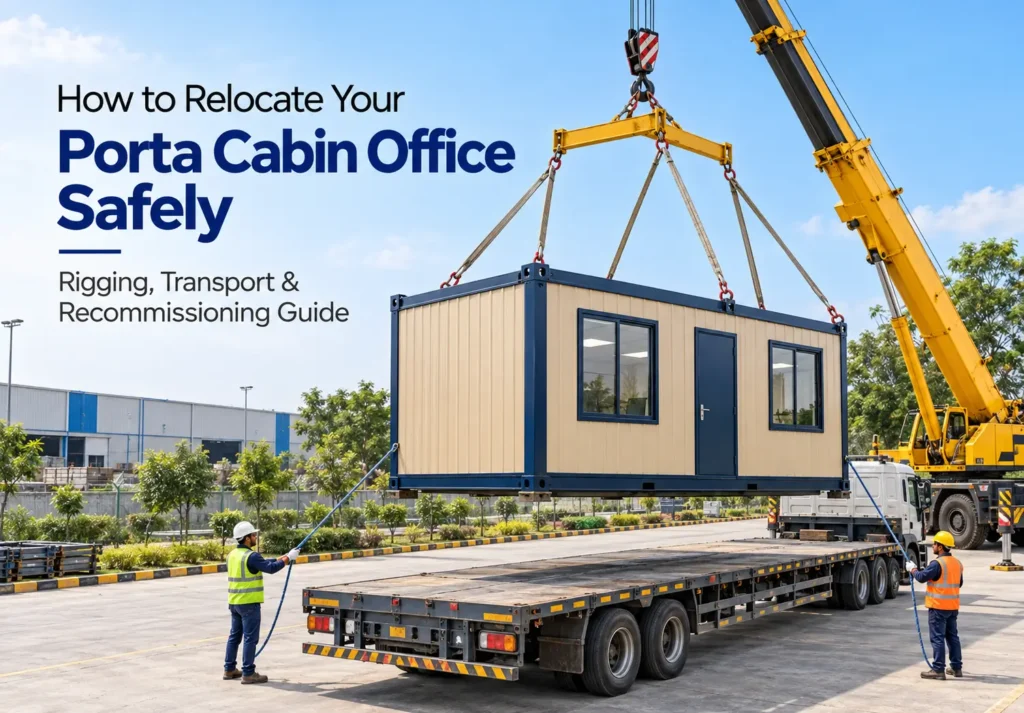
When you invest in a porta cabin office, 100% of the fabrication labor is absorbed inside the manufacturer’s plant. The unit arrives at your project site on a flatbed trailer as a turnkey, plug-and-play module. On-site labor is reduced to a few hours of crane rigging to position the cabin onto its concrete pads and connecting the external main power supply cable to the cabin’s external distribution socket.
4. Time-to-Commissioning and Opportunity Cost
In B2B project management, time equals money. A traditional civil site office takes anywhere from 8 to 16 weeks to become operational, accounting for excavation, brickwork, plaster curing cycles, flooring, and electrical wiring. During Eastern India’s prolonged monsoon season (June through September), heavy rainfall halts outdoor masonry and prevents cement and plaster from curing, extending project delays by months.
During this waiting period, senior engineers, project managers, and administrative staff are forced to operate out of makeshift tents, rented off-site apartments, or distant headquarters—resulting in severe coordination delays, fuel expenses, and lost billable hours. A factory-built Modular Office Cabin is manufactured concurrently while your site is being cleared, typically delivered within 7 to 14 days. Immediate commissioning allows your core engineering team to take command of the site from Day One, accelerating project milestones and protecting contract penalty clauses.
5. Asset Liquidity, Depreciation, and Multi-Project Amortization
The most decisive financial advantage of a Portable Office Container lies in its balance-sheet classification and residual value. Under corporate accounting standards, a brick-and-mortar structure built on leased project land is an immovable expense. When the construction contract ends after 18 or 36 months, the contractor cannot take the building with them. In fact, many land lease agreements along the NH6 industrial belt require the contractor to demolish temporary masonry structures and restore the land to its original state—turning the initial investment into a negative financial liability.
Conversely, a heavy-duty MS porta cabin office is a movable tangible asset. Equipped with reinforced corner castings and overhead crane-lifting hooks, the entire office can be hoisted onto a truck and redeployed to your next infrastructure site in Durgapur, Dankuni, Bhubaneswar, or Jamshedpur. Over a 15-to-20-year structural lifespan, a single cabin can serve across five to आठ distinct projects, reducing the effective infrastructure cost per project to a fraction of its initial purchase price. Furthermore, if your company no longer requires the unit, well-maintained MS portable cabins command a strong resale value of 50% to 70% in the secondary industrial market.
6. Operational Expenditure (OpEx) and Energy Efficiency
Monthly operational costs—primarily air conditioning and lighting—accumulate rapidly over multi-year projects. Traditional single-brick site offices absorb immense solar radiation during Eastern India’s scorching summers, where ambient temperatures routinely exceed 40°C. Brick walls retain heat well into the afternoon, forcing split AC units to run at maximum compressor load continuously, driving up diesel generator fuel consumption or commercial electricity tariffs.
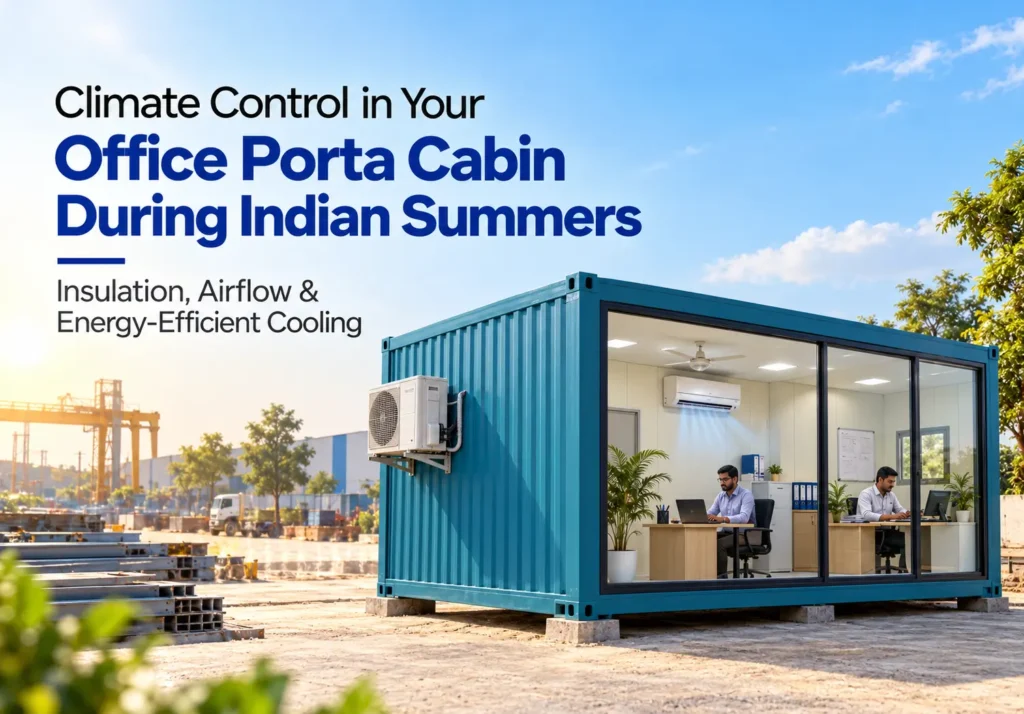
A precision-engineered Readymade Cabin utilizes multi-layered composite wall assemblies with dedicated thermal breaks. High-density Glasswool or Polyurethane Foam (PUF) insulation prevents external solar heat transfer, stabilizing the internal microclimate. Air conditioning systems reach target temperatures faster and cycle off more frequently, cutting HVAC power consumption by 25% to 35% month after month.
Key Features & Materials: Engineering That Protects Your Financial Investment
To realize long-term multi-project ROI, a modular workspace cannot be built from flimsy, low-grade materials that warp or rust after a single monsoon season. At PortaSpaze, every porta cabin office is engineered to industrial heavy-fabrication standards, ensuring structural longevity across decades of rigorous field deployment.
- Heavy-Gauge Mild Steel (MS) Structural Skeleton: The foundation of our durability is a rigid underframe and pillar system fabricated from high-tensile Square Hollow Sections (SHS). For standard 10 ft x 10 ft up to 20 ft x 10 ft office cabins, we utilize heavy 60 mm x 60 mm SHS base framing paired with 72 mm x 72 mm structural corner posts. For expansive 30 ft x 10 ft and 40 ft x 10 ft command centers, the skeleton is upgraded to 72 mm x 72 mm base channels and massive 90 mm x 90 mm corner rigging pillars, topped with 50 mm x 50 mm SHS roof framing. This guarantees zero structural deflection during crane hoisting or multi-axle highway transit.
- Continuously Welded 1.2 mm Corrugated MS Exterior Shell: Unlike bolt-together light-gauge panels that loosen and leak over time, our exterior walls and roof are clad in 1.2 mm thick corrugated Mild Steel sheets. Every seam is continuously fillet-welded by certified fabricators, creating a monolithic, impact-resistant steel armor that withstands flying site debris, heavy wind loads, and unauthorized intrusion.
- High-Density Thermal and Acoustic Insulation Core: Sandwiched within the wall and ceiling cavities is a dense 25 mm Glasswool insulation blanket (with customizable options for 50 mm to 80 mm PUF sandwich panels). Beyond slashing HVAC electricity costs, this core provides vital acoustic dampening—isolating project engineers from the relentless noise of pile drivers, concrete mixers, and highway freight traffic so they can review blueprints and conduct client meetings in peace.
- Premium Interior Cladding and High-Load Flooring: The interior walls and ceiling are finished with moisture-resistant 9 mm Particle Board or sleek, washable 4 mm Aluminium Composite Panels (ACP) that never require repainting or plaster patching. Underfoot, the subfloor is constructed from heavy-duty 18 mm Cement Fiber Board—impervious to termites, rot, and ground dampness—overlaid with a 1 mm thick industrial-grade, anti-skid PVC vinyl mat that handles muddy safety boots with ease.
- Multi-Stage Anti-Corrosive Weatherproofing: Operating in high-humidity zones like Kolkata or saline coastal environments like Haldia demands superior rust protection. Every steel surface undergoes thorough mechanical surface preparation followed by a foundational coat of industrial Red Oxide anti-corrosive primer and two topcoats of weather-grade Synthetic Enamel paint (standard Feroza Blue or customized corporate fleet colors). Furthermore, our 6 ft x 3 ft corrugated MS entrance doors and 3 ft x 3 ft aluminium sliding windows are outfitted with integrated steel safety grills and overhanging rain rail guards to prevent water ingress during cyclonic downpours.
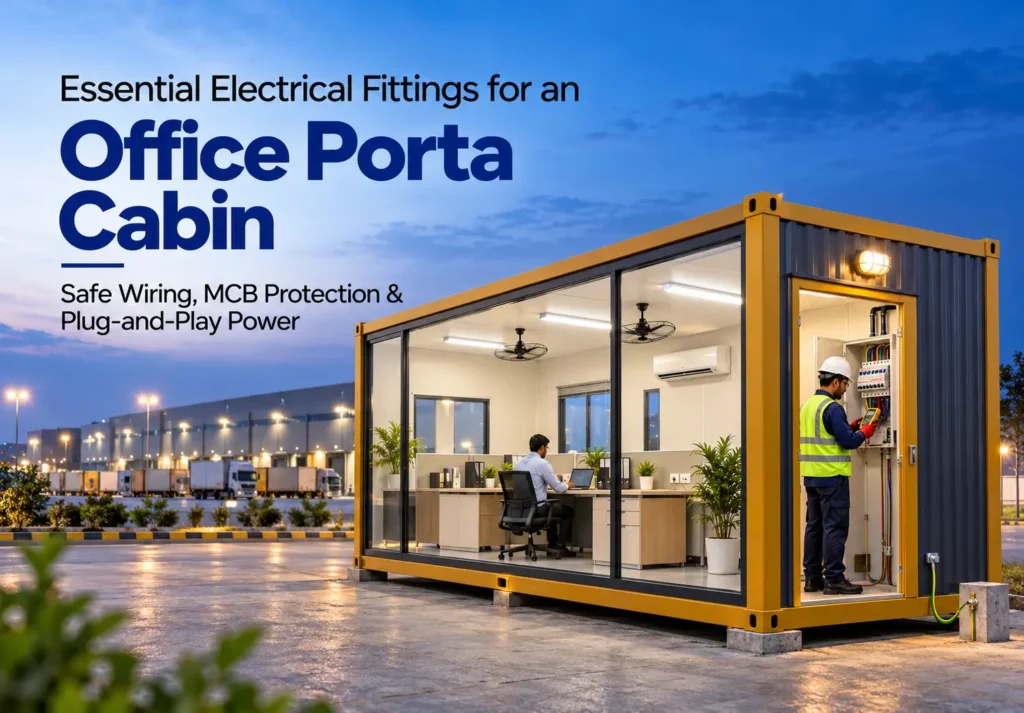
- Turnkey ISI-Certified Electrical Integration: Every Portable Office Container is pre-wired with concealed, fire-retardant copper cabling from top-tier ISI-marked brands (Finolex, Polycab, or Gloster). Standard electrical layouts include dedicated MCB distribution boards, high-lumen LED tube lights, high-speed ceiling cage fans, 6A/16A modular switch sockets for computers and plotters, pre-wired split AC power provisions, and an external weatherproof bulkhead light.
Strategic Comparisons: Modular Office Cabin vs. Traditional Civil Construction
For procurement officers preparing comparative bid evaluations, the financial and operational divergence between a Modular Office Cabin and a conventional brick-and-mortar site office can be broken down across six critical B2B performance parameters:
- Upfront Capital Cost: A prefabricated porta cabin office reduces initial expenditure by 30% to 45% through bulk factory material sourcing, standardized assembly, and the elimination of deep civil foundations. Traditional builds suffer from unpredictable material price surges, multi-trade contractor markups, and costly foundation engineering.
- Deployment & Commissioning Timeline: A Readymade Cabin is fabricated off-site and commissioned within 7 to 14 days, unaffected by local weather conditions. Traditional masonry requires 60 to 120+ days of sequential on-site construction and is frequently paralyzed by monsoon rains and curing delays.
- Asset Mobility & Redeployment: Modular containers offer 100% portability; they can be lifted via crane onto a flatbed truck and relocated to new project sites across Eastern India in a single day. Traditional civil builds have 0% mobility, becoming stranded, unusable structures the moment a project concludes.
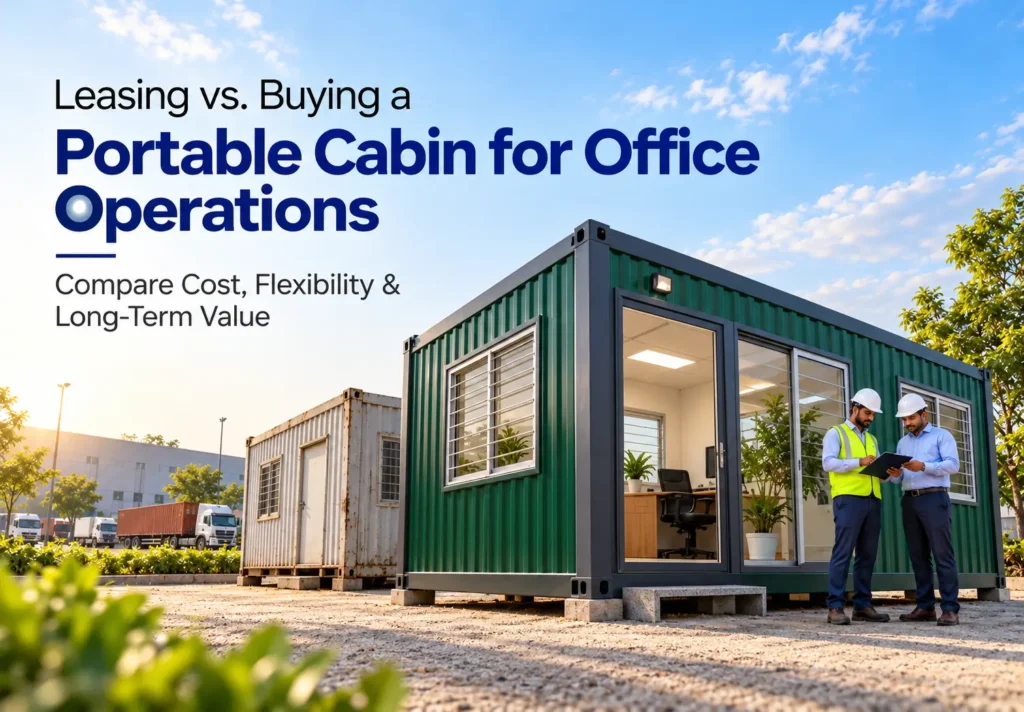
- End-of-Project Residual Value: A heavy-duty MS office cabin retains 50% to 70% of its original value on the secondary market or delivers 100% capital retention when redeployed internally across future contracts. A brick-and-mortar site office yields 0% recovery and incurs negative demolition and debris-removal costs.
- Maintenance & Structural Upkeep: Factory-welded MS shells with ACP interiors and vinyl-topped cement fiber floors require minimal maintenance—primarily periodic exterior enamel touch-ups every few years. Civil site offices built hastily on temporary sites frequently suffer from rising dampness, wall efflorescence, plaster cracking, and roof seepage, demanding constant repair budgets.
- Material Waste & Environmental Compliance: Off-site modular fabrication generates less than 2% material waste and leaves the project site clean, noise-free, and compliant with green corporate mandates. Traditional construction creates massive on-site debris, cement dust pollution, water wastage, and topsoil degradation.
Frequently Asked Questions (FAQ)
How much does a porta cabin office cost compared to a brick-and-mortar building in Kolkata?
On a direct square-foot basis, purchasing a fully outfitted porta cabin office in Kolkata is approximately 30% to 45% more economical upfront than constructing a comparable permanent brick-and-mortar office with similar electrical, flooring, and interior finishes. When you factor in the elimination of deep concrete foundations, zero on-site masonry labor overheads, and the ability to reuse the cabin across four to six subsequent projects over its 15-to-20-year lifespan, the cumulative cost savings exceed 75% to 80% compared to repeatedly building and demolishing civil site offices.
What is the expected lifespan of a Mild Steel Portable Office Container in Eastern India’s climate?
When engineered with heavy-gauge Square Hollow Section (SHS) framing, 1.2 mm continuously welded corrugated Mild Steel sheets, and multi-coat Red Oxide primer plus Synthetic Enamel finishes, a PortaSpaze Portable Office Container easily delivers a structural service life of 15 to 25+ years. Because the subfloor uses rot-proof 18 mm Cement Fiber Board rather than untreated plywood, and the exterior seams are fully welded rather than riveted, the cabin withstands West Bengal’s heavy monsoons, high humidity, and rough crane handling without structural degradation.
Does setting up a Readymade Cabin require municipal building permits or complex foundations?
In the vast majority of industrial zones, highway project corridors, and commercial leases, a Readymade Cabin is classified as a temporary, movable chattel or equipment structure rather than permanent real estate. Consequently, it typically bypasses the lengthy municipal building plan approvals required for permanent civil masonry. For installation, no deep excavation is needed; the unit simply rests on a level ground surface supported by basic concrete pier blocks or a thin surface pad capable of bearing its static weight.
Can we customize and expand our Modular Office Cabin if our project team grows?
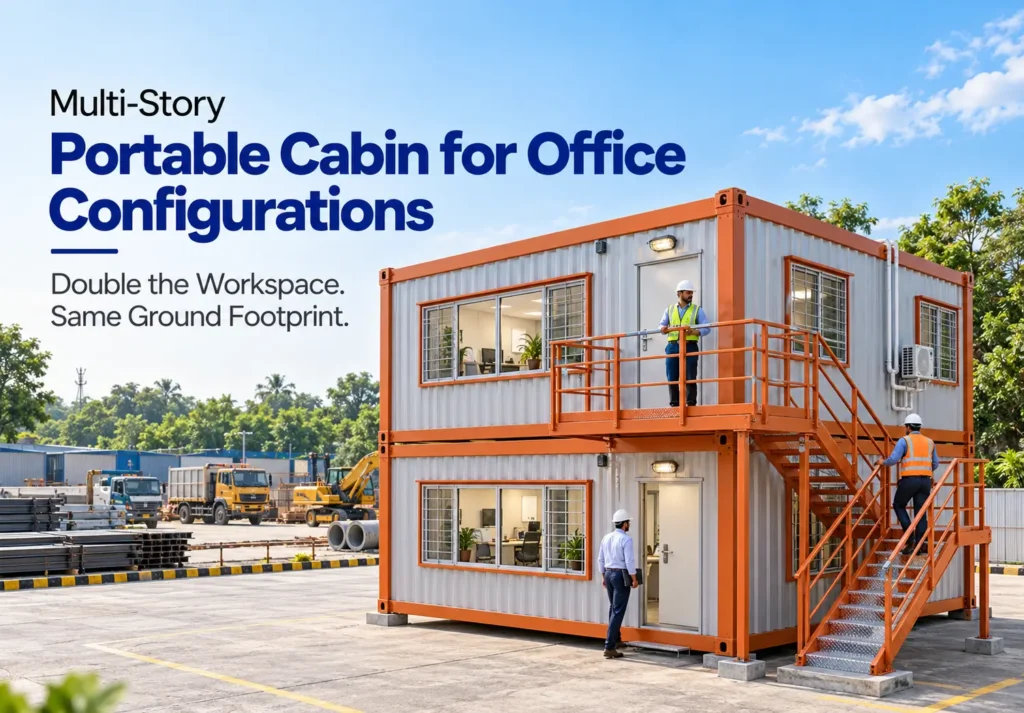
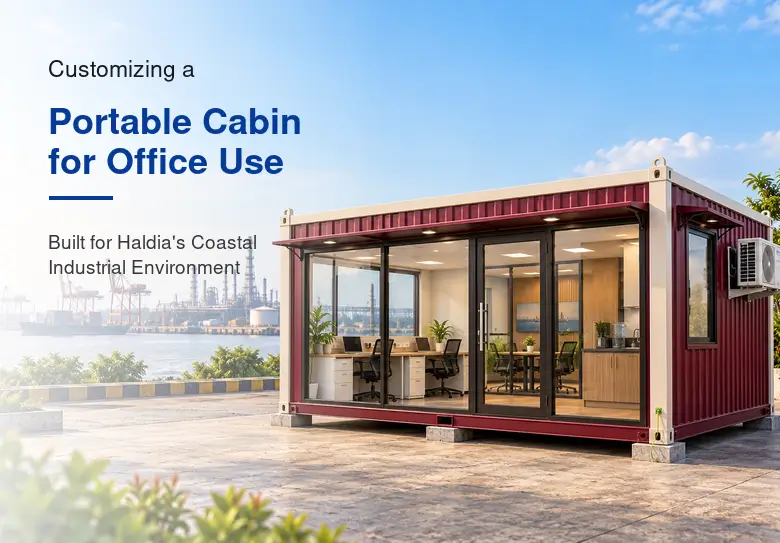
Yes, modular architecture offers unmatched scalability. You can order custom interior configurations—integrating glass partitions for executive cabins, conference zones, attached pantry nooks, or integrated washrooms—directly from the factory. Furthermore, if your engineering workforce expands mid-project, additional Modular Office Cabin units can be delivered and linked side-by-side or stacked vertically (with reinforced structural pillars and external staircases) without disrupting ongoing administrative operations.
Why Choose PortaSpaze for Your Modular Office Infrastructure in Eastern India
Maximizing the financial return on your modular infrastructure requires partnering with a manufacturer that refuses to compromise on metallurgical quality or fabrication precision. Based in Kolkata, PortaSpaze is Eastern India’s trusted leader in heavy-duty prefabricated construction, supplying battle-tested workspace solutions to premier civil contractors, infrastructure developers, and industrial enterprises across West Bengal, the NH6 Corridor, Haldia, Durgapur, Odisha, and Jharkhand.
When you procure a porta cabin office from PortaSpaze, you eliminate middleman markups and gain factory-direct pricing backed by rigorous quality control. Every unit we roll out is built from certified structural Mild Steel, insulated for peak thermal efficiency, and pre-wired with ISI-standard electrical systems so your team can get to work the hour it touches the ground. Whether you need a compact 10 ft x 10 ft site supervisor booth, a standard 20 ft x 10 ft engineering hub, or a bespoke 40 ft x 10 ft corporate command center, our engineering team delivers on time and strictly within budget.
Stop sinking valuable project capital into immovable brick-and-mortar structures. Contact the engineering specialists at PortaSpaze today to discuss your spatial requirements, request a detailed technical datasheet, or secure a competitive, itemized quote for your next project in Eastern India.