Protecting Your Modular Capital Asset in Harsh Industrial Climates
When civil contractors, infrastructure developers, and B2B procurement teams across Eastern India commission a heavy-duty porta cabin office, they are acquiring a high-value corporate asset engineered to serve across 15 to 20+ years of consecutive project lifecycles. Whether your workspace is deployed at a highway expansion hub along the NH6 Corridor, a saline port terminal in Haldia, a metallurgical plant in Durgapur, or an urban metro construction zone in Kolkata, a prefabricated Mild Steel (MS) cabin is built to endure extreme operational environments.
However, even the toughest industrial steel structure is not immune to neglect. Active project sites subject modular buildings to relentless environmental and mechanical stress: torrential monsoon downpours, 42°C summer UV radiation, corrosive chemical particulates, ground settlement under crane pads, and heavy daily foot traffic from workers in muddy safety boots. Left unchecked for months, minor issues—such as a clogged roof scupper, a deep scratch in the exterior enamel coating caused by passing site machinery, or a loose earthing terminal—can escalate into costly structural corrosion, water seepage, or electrical downtime.
Implementing a disciplined, standardized monthly maintenance protocol takes less than two hours for a site supervisor or facility technician to execute, yet it adds decades to the functional lifespan and resale equity of your Modular Office Cabin. This comprehensive technical guide provides a complete monthly inspection checklist, seasonal monsoon and summer care protocols, and component-specific upkeep standards tailored for modular workspaces in Eastern India.
Core Topic Deep-Dive: The Complete Monthly Maintenance Checklist for Your Porta Cabin Office
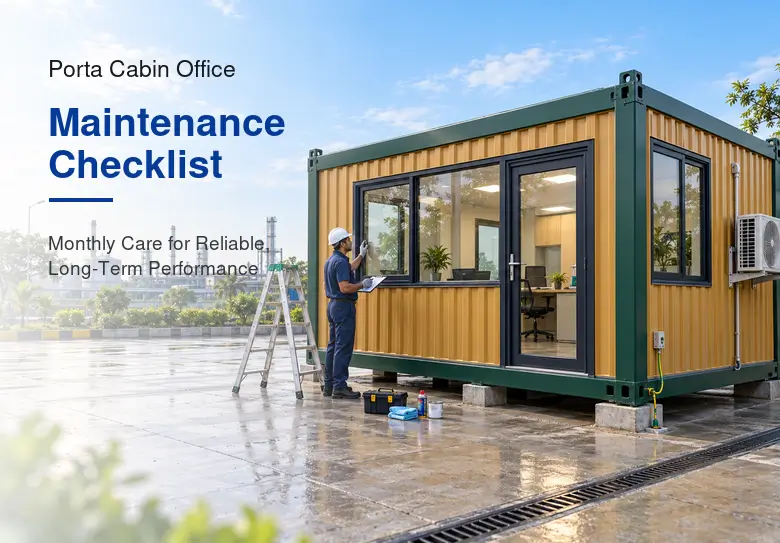
To prevent unexpected repairs and preserve 100% asset readiness for future site-to-site relocations, site engineers should divide their monthly porta cabin office audit into six systematic engineering zones: the exterior MS shell and roof, structural base and foundation leveling, glazing and entry hardware, interior cladding and flooring, electrical safety harnesses, and HVAC climate systems.
1. Roof Drainage, Welded Seams, and Exterior MS Shell Audit
The exterior envelope of a Portable Office Container is your first line of defense against West Bengal’s punishing climate. Once every 30 days, perform a full perimeter walk-around and safe ladder inspection of the roof plane:
- Clear Roof Debris and Standing Water: Construction sites kick up massive amounts of cement dust, falling leaves, and windblown plastic. When wet, this debris forms an acidic sludge on the 1.2 mm corrugated MS roof sheets that traps moisture and blocks rainwater run-off. Sweep the roof completely clean every month so rainwater drains freely over the eaves.
- Inspect Continuous Weld Seams and Top Rigging Lugs: Examine the perimeter weld lines along the 50 mm x 50 mm Square Hollow Section (SHS) top frame and the four corner crane-lifting hooks. Clear away any accumulated mud or bird droppings around the lifting lugs, ensuring the weld fillets remain clean and intact for your next crane hoist.
- Touch Up Mechanical Scratches Immediately: On busy industrial yards, flying gravel or careless material handling can scratch the exterior paint down to bare steel. In humid regions like Kolkata or coastal Haldia, exposed Mild Steel begins oxidizing within days. Keep a small touch-up kit of industrial Red Oxide anti-rust primer and matching Synthetic Enamel paint (such as Feroza Blue) on-site to seal deep scratches during your monthly check.
- Wash Down Chemical and Saline Deposits: If your cabin is situated near chemical cooling towers, coal yards, or coastal jetties, hose down the exterior corrugated walls once a month with clean, low-pressure water and a mild neutral detergent to remove corrosive salt and soot buildup.
2. Under-Frame Clearance, Pier Leveling, and Soil Settlement Checks
Because a Readymade Cabin sits on surface pier blocks or a thin concrete plinth rather than deep civil pilings, heavy monsoon rains can occasionally soften the surrounding soil and cause uneven ground settlement.
- Verify Foundation Leveling and Plumb Alignment: Place a spirit level along the interior floor and check if all four corners of the 60×60 mm or 72×72 mm SHS base frame are sitting firmly on their concrete support piers. If one corner pier has sunk by even half an inch into soft alluvial soil, the structural frame can rack slightly—manifesting first as a main door or sliding window that suddenly feels stiff to latch. Insert mild steel packing shims onto the low pier block to restore perfect horizontal alignment.
- Maintain Under-Belly Airflow Clearance: Inspect the 6-to-12-inch crawlspace beneath the cabin. Ensure that site mud, weeds, or construction rubble have not piled up against the bottom SHS steel channels. Unobstructed under-floor airflow prevents ground dampness from wicking upward and stops rust from forming on the underside of the base frame.
3. Doors, Windows, Safety Grills, and Weather Seal Maintenance
Entryways and windows experience the highest mechanical wear in any porta cabin office, being opened and slammed dozens of times per shift.
- Vacuum and Lubricate 3 ft x 3 ft Aluminium Window Tracks: Fine silica sand and cement dust inevitably settle into the bottom sliding tracks of powder-coated aluminium windows. If left uncleaned, grinding grit wears down the bottom nylon rollers and jams the sash. Brush or vacuum out the window tracks monthly and apply a light dry silicone spray (avoid heavy grease, which traps more dust).
- Inspect Rubber Gaskets and Rain Rail Guards: Check the perimeter EPDM rubber beading around the window glass and verify that the exterior overhanging rain rail guards are clear of debris and firmly welded, preventing wind-driven rainwater from seeping indoors.
- Service the 6 ft x 3 ft MS Entrance Door Hardware: Apply a few drops of machine oil or white lithium grease to the ISI-marked stainless steel hinges, inside/outside hatch bolts, and mortise lock latches on the main corrugated MS door. Confirm that the overhead rain guard above the doorway is clean and diverting water away from the threshold.
4. Interior Cladding, Thermal Integrity, and Flooring Upkeep
Maintaining a clean, corporate-grade interior protects employee morale and prevents moisture from compromising the 18 mm Cement Fiber Board subfloor.
- Sanitize 1 mm PVC Vinyl Flooring & Protect Against Point Loads: Muddy safety boots track abrasive grit onto the floor daily. Beyond daily sweeping, perform a monthly deep clean of the 1 mm thick PVC Vinyl floor mat using a damp mop and mild pH-neutral floor cleaner (never flood the floor with buckets of standing water). Check that heavy metal desk legs and filing cabinets are fitted with rubber or felt caster pads so they do not tear or indent the vinyl layer.
- Wipe Down 4 mm ACP or 9 mm Particle Board Walls: For cabins finished with 4 mm Aluminium Composite Panels (ACP), wipe down the walls and ceiling monthly with a soft microfiber cloth to maintain high LED light reflectivity. For cabins lined with 9 mm Particle Board, inspect corner joints and window sills to ensure no condensation or accidental water spills from water dispensers are sitting against the board edges.
- Check Wall Cavities for Moisture or Pest Intrusion: Ensure all internal H-jointers, corner trims, and skirting boards are tightly secured so that the internal 25 mm Glasswool or PUF thermal insulation core remains completely sealed off from ambient humidity and insects.
5. Electrical Distribution Board, Earthing, and Fixture Audits
Electrical safety is paramount inside a conductive steel structure operating on volatile site power grids or Diesel Generators (DG sets). Every month, your site electrician should complete a 15-minute electrical check:
- Test the RCCB/ELCB Test Button & Inspect MCBs: Open the 220–240V Main Distribution Board and press the “Test” button on the Residual Current Circuit Breaker (RCCB/ELCB) to verify that the earth-leakage trip mechanism responds instantly. Check all individual Miniature Circuit Breakers (MCBs) for any signs of thermal discoloration, buzzing, or loose terminal screws caused by transport or generator vibration.
- Audit External Chassis Earthing Continuity: Walk outside and inspect the external earthing lug welded to the bottom SHS base frame. Verify that the GI earthing strip or braided copper grounding cable bolted to the cabin is tight, free of rust, and securely connected to a watered site earth pit.
- Clean Ceiling Rotary Cage Fans & LED Fixtures: Construction dust coats fan blades and protective wire cages rapidly, reducing airflow efficiency and causing motor imbalance. Wipe down the blades and cages of all high-speed ceiling rotary cage fans, clean the diffusers on the internal LED tube lights, and check the glass gasket on the external weatherproof bulkhead light to ensure no rainwater or insects have entered the housing.
6. HVAC Climate Control and Wet Pantry/Sanitation Checks
In dusty industrial corridors like Dankuni, Uluberia, and Haldia, split air conditioners clog up three times faster than in residential buildings.
- Wash Split AC Nylon Mesh Filters Twice Monthly in Summer: Pop open the front panel of the indoor split AC unit and rinse the nylon dust filters under running water. Clogged filters choke airflow, cause ice buildup on the evaporator coils, and increase AC electricity consumption by 15% to 25%.
- Flush AC Condensate Drain Lines & Check Outdoor Brackets: Pour a cup of clean water through the AC condensate drain pipe to ensure algae or site dust hasn’t blocked the line—preventing water from overflowing down the interior cabin wall. Outside, verify that the heavy-duty MS mounting brackets holding the outdoor compressor unit are tightly bolted and vibration pads are intact.
- Inspect Optional Pantry & Washroom Plumbing: If your Modular Office Cabin includes an integrated wet pantry or executive washroom, check under the stainless steel sink for P-trap drips, verify that CPVC inlet valves and UPVC drain couplings are dry, and clean the overhead water tank strainer.
Key Features & Materials: Why PortaSpaze Cabins Require Minimal Upkeep
The secret to effortless monthly maintenance starts at the manufacturing stage. Inferior modular cabins built with thin riveted sheets, untreated commercial plywood floors, and low-grade local wiring require constant, expensive repairs. At PortaSpaze, every porta cabin office fabricated at our Kolkata plant is engineered with industrial-grade materials specifically chosen to minimize maintenance overheads:
- Heavy-Gauge SHS Structural Skeleton: We construct our base frames from 60 mm x 60 mm Square Hollow Sections (SHS) with 72 mm x 72 mm corner posts for 10 ft to 20 ft cabins, and upgrade to massive 72 mm x 72 mm SHS base frames with 90 mm x 90 mm corner posts for 30 ft and 40 ft units (topped with 50 mm x 50 mm SHS roof frames). This rigid chassis resists warping, keeping doors and windows permanently aligned.
- Continuously Welded 1.2 mm Corrugated MS Exterior: Unlike bolted or riveted panel cabins where rubber seam sealants dry out and leak every monsoon, our 1.2 mm thick corrugated Mild Steel walls and roofs are continuously seam-welded into a monolithic, maintenance-free steel shell.
- Dual-Layer Anti-Corrosive Coating System: Every steel surface is mechanically prepared and coated with an industrial Red Oxide anti-rust primer followed by two coats of premium Synthetic Enamel paint (Asian, Berger, or Nerolac in Feroza Blue or custom corporate colors), providing multi-year protection against humidity and UV degradation.
- Rot-Proof 18 mm Cement Fiber Board Flooring: By replacing traditional plywood with an 18 mm Cement Fiber Board base topped with 1 mm anti-skid PVC Vinyl, we eliminate the risk of termite attacks, fungal rot, and subfloor swelling permanently.
- Sealed 25 mm Glasswool Insulation & Washable Cladding: Our non-combustible 25 mm Glasswool thermal core (or optional PUF panels) never slumps or degrades, while our 9 mm Particle Board and 4 mm ACP interior finishes require zero whitewashing or plaster patching.
- ISI-Certified Concealed Copper Electrification: Pre-wired with fire-retardant copper cables from Polycab, Finolex, Havells/Reo, Mescab, Gloster, or V-Guard, routed safely behind walls to prevent accidental mechanical damage.
Strategic Comparisons: Maintaining a Modular Office Cabin vs. Traditional Civil Construction
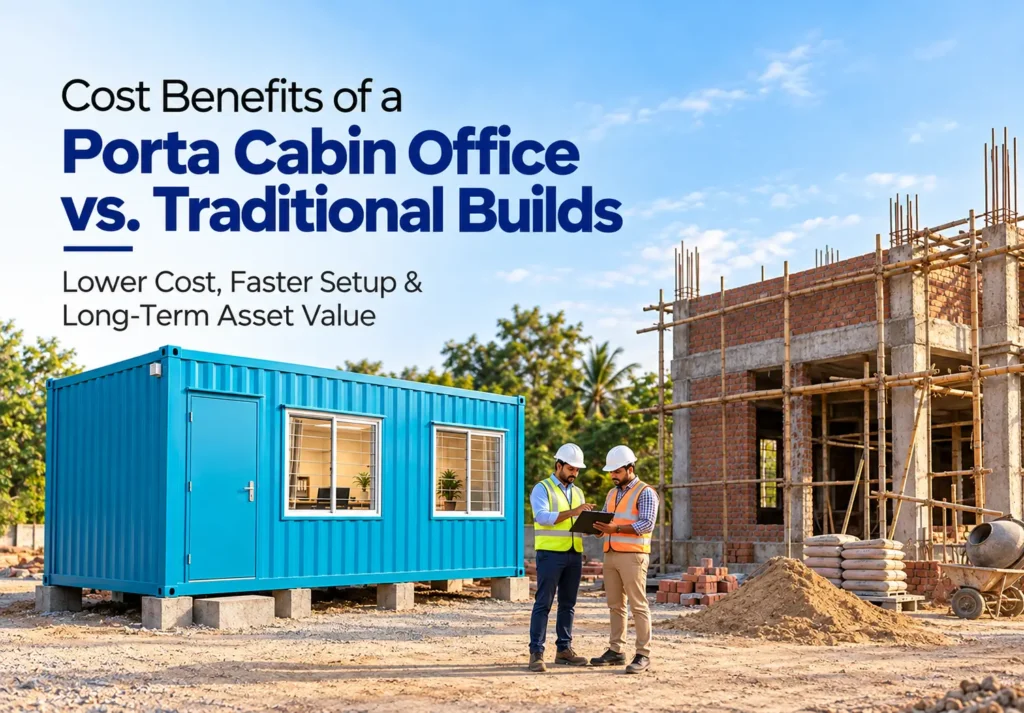
When B2B procurement teams and facility managers compare the ongoing maintenance burden of a Portable Office Container against a conventional brick-and-mortar site office, the operational savings are substantial:
- Elimination of Rising Damp & Plaster Efflorescence: Temporary brick-and-mortar site offices built hastily on high-water-table soils in Kolkata or Haldia inevitably suffer from capillary rising damp, peeling paint, salt efflorescence (salinity eating away brick mortar), and hairline structural cracks. A raised steel porta cabin office is completely isolated from ground moisture, eliminating masonry and plaster repairs entirely.
- Roof Waterproofing Longevity: Flat concrete roofs on civil site offices frequently develop thermal cracks that seep water during monsoons, requiring expensive tar-felt or chemical waterproofing treatments every two years. A continuously welded, corrugated MS roof sheds water immediately and requires only a simple monthly sweeping.
- Predictable Upkeep Costs & Zero Demolition Liability: Maintaining a modular cabin requires only basic cleaning and an exterior enamel repaint every 3 to 5 years to look brand new. Furthermore, at the end of a contract, your well-maintained Readymade Cabin retains 100% of its utility for relocation—whereas every rupee spent maintaining a brick site office is lost when the building is demolished.
Frequently Asked Questions (FAQ)
How often should the exterior of a porta cabin office be repainted in Eastern India?
Because every PortaSpaze porta cabin office leaves our factory treated with an industrial Red Oxide anti-corrosive primer and two topcoats of weather-grade Synthetic Enamel paint, a full exterior repaint is typically only needed once every 3 to 5 years (or every 2 to 3 years in highly corrosive coastal chemical zones like Haldia). Performing a quick monthly walk-around to touch up any deep mechanical scratches caused by site equipment will keep rust completely at bay between scheduled repainting cycles.
What is the best way to prevent roof leaks on a Portable Office Container during heavy monsoons?
A PortaSpaze Portable Office Container features a continuously seam-welded 1.2 mm corrugated Mild Steel roof, meaning there are no bolted roof joints or rubber roof gaskets to leak. The only maintenance required before and during the monsoon is sweeping off accumulated cement dust, leaves, and site debris once a month so rainwater can flow freely off the corrugations without pooling, and verifying that window rain rail guards are unobstructed.
How do we maintain the 18 mm Cement Fiber Board and PVC Vinyl flooring inside a Readymade Cabin?
Maintaining the floor of your Readymade Cabin is effortless. Sweep or vacuum loose site grit daily so muddy safety boots do not abrade the surface, and damp-mop the 1 mm PVC Vinyl layer weekly or monthly using a mild, neutral floor cleaner. Avoid pouring buckets of standing water inside the cabin, and place rubber or plastic protective caps under the sharp metal legs of heavy office desks and filing cabinets.
Can PortaSpaze assist with refurbishing or upgrading an older Modular Office Cabin?
Yes. As a full-scale manufacturer headquartered in Kolkata, PortaSpaze supports long-term fleet lifecycle management across Eastern India. Whether you need technical guidance on routine upkeep, replacement hardware after years of heavy field use, or wish to expand your existing Modular Office Cabin setup with newly fabricated units along the NH6 Corridor, Durgapur, or Haldia, our engineering team is ready to assist.
Why Choose PortaSpaze for Low-Maintenance, Heavy-Duty Modular Workspaces
The best maintenance strategy begins with buying a cabin engineered not to break down in the first place. Headquartered in Kolkata, PortaSpaze is Eastern India’s trusted leader in heavy-duty modular construction, delivering rugged, low-maintenance administrative infrastructure to top civil contractors, industrial plants, mining operations, and logistics hubs across West Bengal, the NH6 Corridor, Haldia, Dankuni, Durgapur, Odisha, and Jharkhand.
Every porta cabin office we manufacture is built for decades of trouble-free performance—combining heavy-gauge SHS steel skeletons, continuously welded 1.2 mm corrugated MS armor, 25 mm Glasswool thermal insulation, termite-proof 18 mm Cement Fiber Board flooring, and concealed ISI-certified Finolex/Polycab electrical systems. From compact 10 ft x 10 ft supervisor cabins to 40 ft x 10 ft corporate command centers, our turnkey structures let your project managers focus on building infrastructure rather than fixing their office.
Invest in a modular workspace built to outlast the toughest project sites. Contact the engineering specialists at PortaSpaze today to request a detailed technical specification sheet or secure a fast, factory-direct quote for your next deployment in Eastern India.