Introduction: Ensuring Business Continuity Across Industrial Zones
For project managers, site engineers, and B2B procurement teams operating in Eastern India, successfully completing a large-scale infrastructure project in Kolkata or Haldia often means immediately shifting focus to the next major industrial frontier. Durgapur, known globally for its massive steel, power, and heavy manufacturing industries, is a frequent destination for expanding corporate operations and contracting consortiums. However, transitioning your site infrastructure seamlessly across the state without incurring massive administrative downtime is a complex logistical challenge. The most strategic asset your engineering team possesses during this transitional phase is a mobile, prefabricated workspace. By professionally disconnecting, hoisting, and transporting your office porta cabin, you completely bypass the crippling delays and sunk costs associated with constructing a brand-new brick-and-mortar facility at the new site.
In the modern industrial landscape, agility equates to profitability. A highly durable, prefabricated workspace allows your administration, quality control teams, and project executives to pack up their operations on a Friday in Kolkata and plug their servers back in on a Monday in Durgapur. This comprehensive logistics guide breaks down the precise technical methodologies, safety protocols, transport routing, and structural engineering advantages of relocating your Modular Office Cabin. By following these B2B guidelines, you will ensure your heavy-duty infrastructure survives the highway transit and your team remains fully operational from day one at the new location.
Core Topic Deep-Dive: Relocating Your office porta cabin Safely
Transporting a fully furnished Portable Office Container across the NH19 (formerly NH2) highway requires meticulous logistical coordination. It is not simply a matter of placing a steel box onto a transport truck; it involves precise center-of-gravity calculations, crane rigging, and securing internal payloads. Project managers must execute a phased relocation strategy to ensure the safety of the asset, the transport crew, and the expensive corporate technology housed inside.
Phase 1: Pre-Move Site Decommissioning and Internal Securing
The relocation process begins days before the crane arrives on site. The primary objective is to sever all external utility connections safely while securing the interior to prevent damage from highway vibrations. First, certified electricians must properly decouple the cabin from the main industrial power grid, ensuring all external input sockets and MCB distribution boards are capped and weatherproofed. Water and sewage lines connected to integrated sanitation units or pantries must be drained and sealed.
Internally, all loose furniture, blueprint tables, and ergonomic chairs should be strapped down or temporarily removed. Standard-height corporate desks that are bolted to the 18 mm cement fiber board sub-floor can remain in place, provided that computer monitors, servers, and sensitive IT equipment are securely packed in shock-absorbent transit crates. Sliding aluminium windows must be fully closed, locked, and their external steel safety grills checked for tight fastening to prevent wind shear damage during high-speed transit.
Phase 2: Heavy-Duty Crane Rigging and Loading
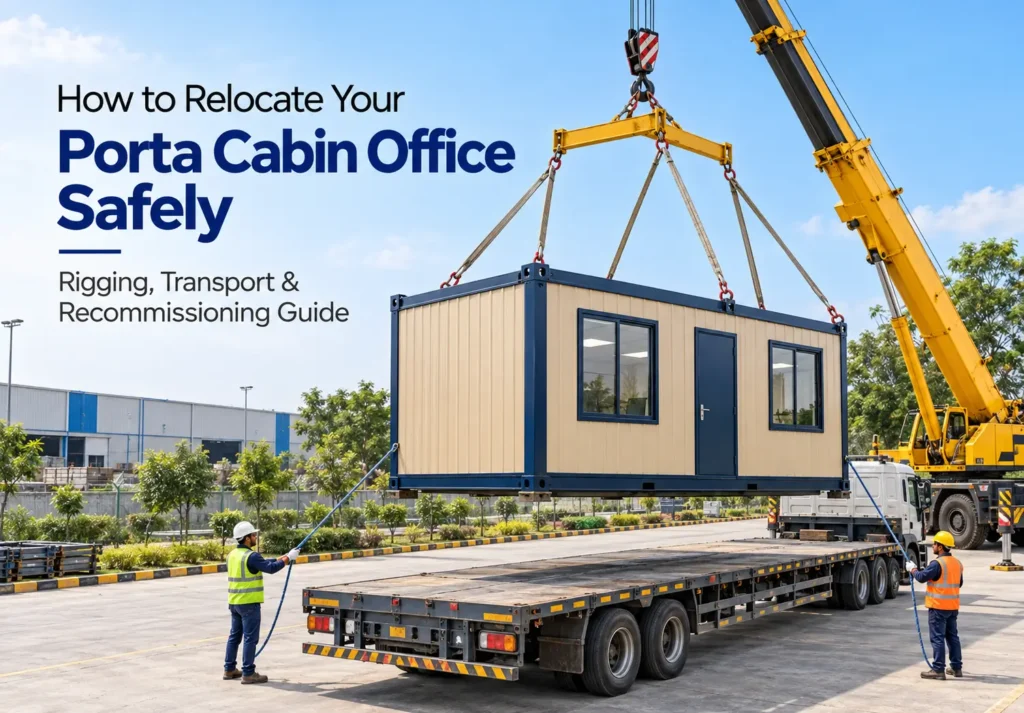
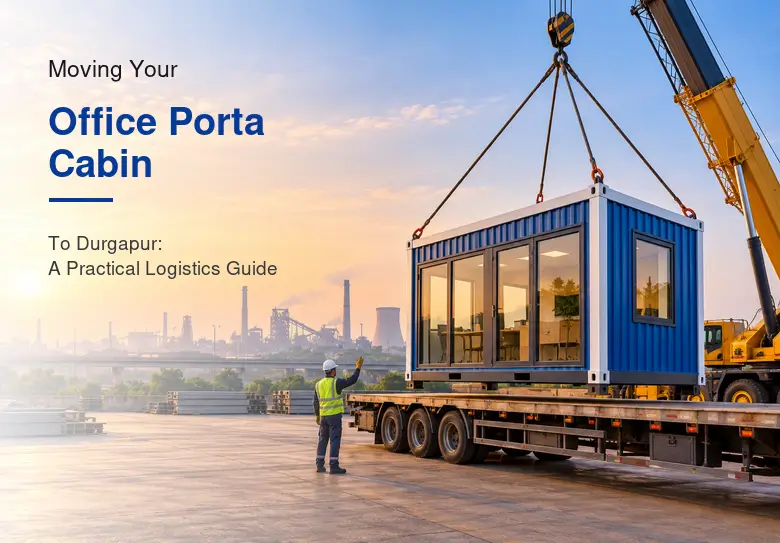
The structural genius of a premium Readymade Cabin lies in its integrated lifting mechanisms. Unlike temporary sheds that buckle under their own weight, our cabins are engineered with heavy-duty corner castings and top rigging lifting lugs welded directly into the 72×72 mm or 90×90 mm Square Hollow Section (SHS) corner posts. When the mobile crane arrives, rigging specialists will attach four high-tensile lifting slings to these top lugs.
This four-point top-lift ensures that the immense weight of the steel cabin is distributed perfectly across the reinforced structural frame, preventing any torsional twisting or chassis bending as it is hoisted into the air. The cabin is then gently lowered onto the bed of a standard flatbed trailer. Once seated, the transit crew will utilize heavy-duty chain binders and nylon ratchet straps, securing the lower corner castings directly to the trailer bed to ensure absolute immobility during the journey.
Phase 3: Highway Transit Routing to Durgapur
The journey from Kolkata or the NH6 Corridor to Durgapur covers approximately 170 to 200 kilometers, depending on the exact origin point. Navigating a wide-load Portable Office Container requires an experienced logistics partner familiar with the Durgapur Expressway (NH19). The transport route must be surveyed for low-hanging high-tension power lines, narrow toll booth lanes, and active highway construction zones. Because standard modular units are typically 10 feet wide, they fit safely on commercial flatbed trailers without requiring specialized wide-load highway escorts in most instances, streamlining the transit timeline and reducing transport fees.
Phase 4: Site Preparation and Deployment in Durgapur
While the cabin is in transit, the advance team in Durgapur must prepare the receiving site. Modular infrastructure requires zero deep foundation digging, which drastically accelerates deployment. The designated plot should be graded and leveled. Simple concrete pedestal blocks or a level concrete plinth should be arranged to match the dimensions of the base frame. Elevating the unit slightly on these blocks ensures proper ground drainage during heavy monsoons and prevents ground-borne moisture from affecting the steel undercarriage. Once the flatbed arrives, a local crane hoists the unit off the truck and directly onto the pedestals. External power and data lines are plugged in, and the workspace is instantly revitalized.
Key Features & Materials: Engineered for Highway Transit
A flimsy, sub-standard cabin will suffer severe structural fatigue, cracked joints, and internal panel warping during a bumpy highway journey. To achieve ultimate site mobility, the structure must be manufactured with uncompromising industrial materials. Here is why PortaSpaze units are highly sought after by B2B procurement teams who require frequent relocations.
Continuous Seam Welding and MS Steel Durability
The foundation of our mobile engineering is the structural shell. We utilize fully continuous-welded 1.2 mm thick corrugated Mild Steel (M.S.) exterior sheets over heavy SHS base frames. Rather than relying on rivets or weak spot-welds that can shear off under transit vibrations, continuous seam welding creates a rigid, monolithic steel box. This ensures that the cabin maintains its absolute weather-tight integrity, protecting your assets from driving rain and wind while moving at highway speeds.
Vibration-Resistant Insulation Cores
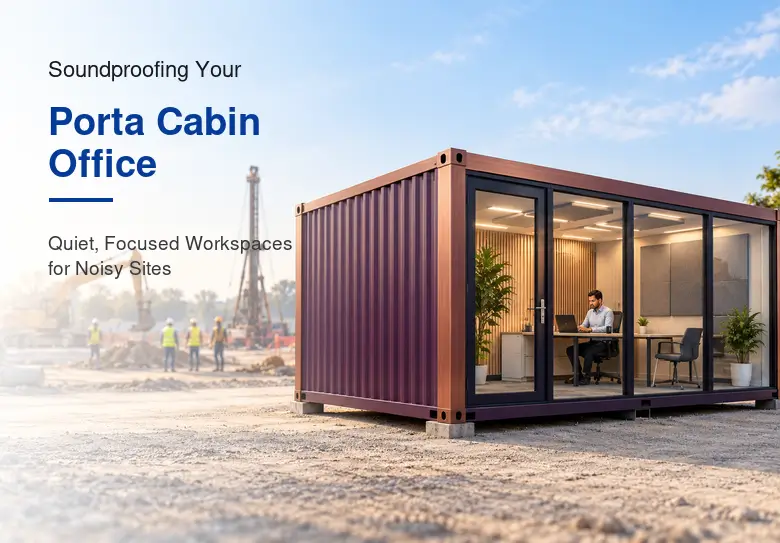
Inferior insulation materials tend to settle, bunch up, or degrade when subjected to the constant shaking of a flatbed truck, leaving gaps in your thermal envelope. Our cabins utilize high-density 25 mm Glasswool or Polyurethane Foam (PUF) insulation cores that are firmly bonded and compressed between the corrugated exterior and the interior cladding. This ensures the thermal and acoustic barrier remains perfectly intact upon arrival in Durgapur, guaranteeing that your air conditioning units will function with maximum efficiency in the intense industrial heat.
Rigid Interior Cladding and Flooring Systems
The internal aesthetics of a premium modular office are designed to survive movement. We utilize 9 mm Particle Board or 4 mm Aluminium Composite Panel (ACP) wall cladding, which flexes just enough to absorb transit shocks without cracking. The foundation of the cabin consists of a rigid 18 mm heavy-duty Cement Fiber Board base topped with a 1 mm to 1.5 mm thick PVC Vinyl mat. This heavy sub-floor stabilizes the entire unit, ensuring that the base does not warp when lifted by the crane or bounce aggressively during transport.
Industrial Anti-Rust Treatments
Relocating a cabin from the humid, coastal air of Kolkata to the dry, dusty, and chemical-heavy atmosphere of Durgapur’s steel belt requires superior surface protection. Every inch of our steel frame undergoes an intensive anti-rust treatment. We apply a heavy-duty industrial Red Oxide primer followed by two thick coats of premium weather-grade Synthetic Enamel paint. This dual-layer defense prevents oxidation, scratches from transport chains, and industrial corrosion, ensuring the asset looks highly professional when it lands on the new site.
Strategic Comparisons: Relocating Modular Solutions vs. Rebuilding Civil Infrastructure
When B2B project managers evaluate the logistics of opening a new site in Durgapur, the financial and operational comparison between moving a modular asset versus constructing a new traditional building heavily favors the prefabricated approach.
Capital Preservation and Compounding ROI
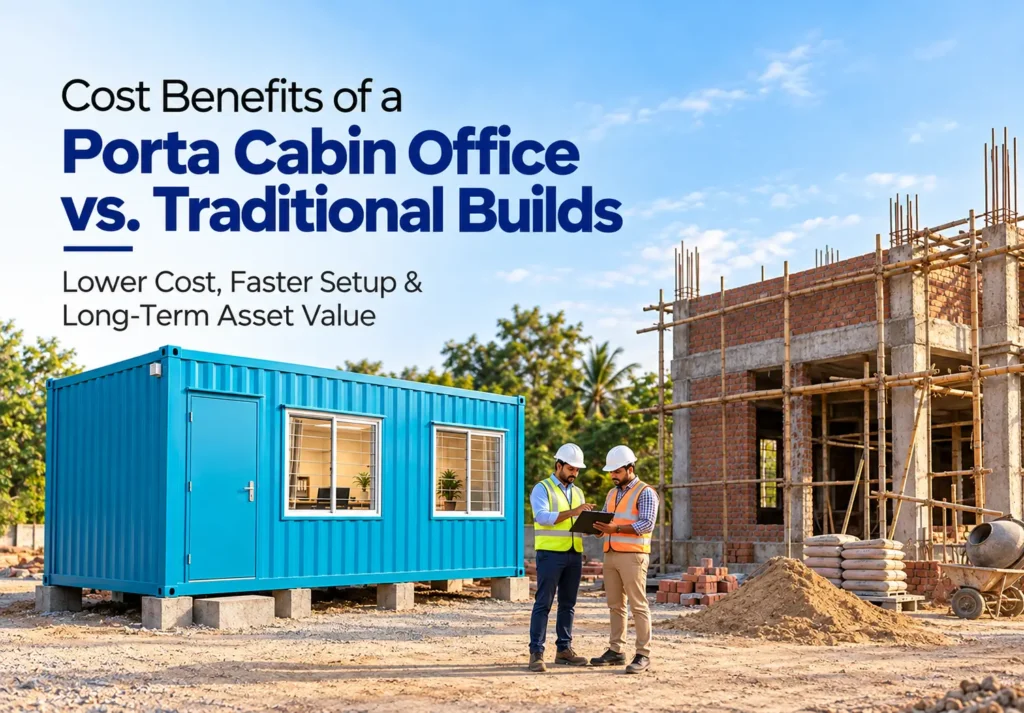
If you rely on traditional brick-and-mortar site offices, the end of your project in Kolkata means the end of that asset. You must abandon or demolish the concrete building, resulting in a 100% loss of the sunk capital. Furthermore, you must allocate a massive new budget to construct a duplicate building in Durgapur. By investing in a modular structure, you purchase the asset once. The cost of a crane hoist and a flatbed transport truck is a microscopic fraction of the cost of a new civil build. This asset retention delivers a compounding Return on Investment (ROI) that civil construction simply cannot compete with.
Eliminating Site Downtime
Time is the most expensive variable in industrial contracting. Building a new concrete office in Durgapur requires municipal permits, material curing times, and navigating unpredictable local labor markets. It can take months before your administrative team has a secure place to work. Transporting your existing modular cabin takes a single day. This rapid deployment means your engineers, HR personnel, and project managers experience zero operational downtime. They leave the old site on Friday and commence deep, focused work at the new site on Monday.
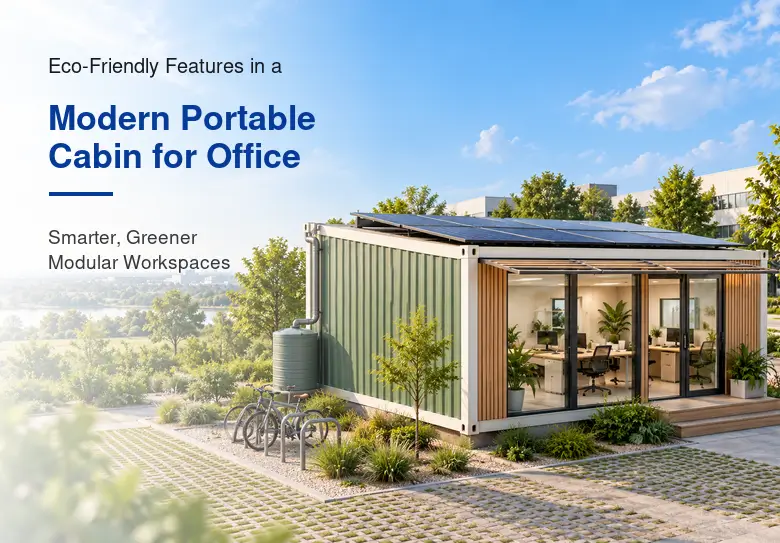
Eco-Friendly Site Management
Civil builds heavily disrupt local topsoil, generate vast amounts of dust, and leave behind non-recyclable debris at both the decommissioned site and the new site. Relocating a prefabricated cabin leaves the Kolkata plot entirely clean and undisturbed, eliminating post-project landscaping fines. Upon arrival in Durgapur, the drop-and-play installation generates zero construction waste, actively reducing your corporation’s environmental footprint.
Frequently Asked Questions (FAQ)
Do I need special transport permits to move a Portable Office Container to Durgapur?
In most cases, no. Standard manufactured footprints, such as the widely used 20 ft x 10 ft or 40 ft x 10 ft configurations, conform to the dimensional limits of standard commercial flatbed trailers operating on Indian national highways. Because they do not typically exceed the width restrictions that classify a load as an “oversized convoy,” you can avoid the complex bureaucracy and expense of specialized wide-load highway escorts, making the logistics highly straightforward.
How do I prepare the new site in Durgapur for the cabin’s arrival?
Site preparation is minimal but crucial. The designated ground must be cleared of major debris and roughly leveled by a backhoe or grader. We recommend laying down a series of simple concrete pedestal blocks aligned with the cabin’s structural base frame. Elevating the unit 6 to 12 inches off the dirt ensures excellent drainage during the monsoon season and prevents ground moisture from interacting with the steel undercarriage. Ensure that your new site has the main electrical and water supply lines routed to the pedestal area prior to the crane’s arrival for instant plug-and-play connection.
Will the Glasswool or PUF insulation degrade during the highway transport?
No. When engineered by a certified manufacturer, the insulation core is firmly secured. High-density Polyurethane Foam (PUF) is injected and bonds directly to the inner and outer panel walls, creating a rigid, unified sandwich panel that is entirely immune to settling or vibration damage. Similarly, our heavy-duty Glasswool batts are mechanically fastened within the wall cavities, ensuring your thermal and acoustic barriers remain 100% intact upon arrival in Durgapur.
Can multiple Modular Office Cabin units be moved and re-linked at the new location?
Absolutely. One of the greatest advantages of modular infrastructure is its scalability. If your operations in Kolkata utilized a sprawling, interconnected complex of multiple cabins, the transit crew will simply unbolt the joining flashings, disconnect the bridging electrical harnesses, and transport the units individually. Once they arrive in Durgapur, the crane will place them side-by-side on the new pedestals, and they can be seamlessly re-linked, restoring your massive multi-desk headquarters in a matter of hours.
Why Choose PortaSpaze for Your Next Industrial Deployment
Do not let the archaic, slow, and financially draining methods of traditional civil construction dictate your project timelines across Eastern India. As a premier manufacturer of heavy-duty modular infrastructure, PortaSpaze provides B2B procurement teams and contractors with the ultimate strategic advantage: complete operational mobility. We engineer rugged, heavily insulated, and highly professional workspaces tailored precisely to survive constant relocation, harsh industrial climates, and demanding corporate workflows.
Whether you require a compact security checkpoint, a mobile material testing laboratory, or a sprawling 40-foot multi-desk engineering command center, our turnkey structures guarantee that your business is operational, secure, and professional from the very first day on any new site. Preserve your capital, eliminate construction delays, and empower your remote teams to move faster. Contact PortaSpaze today to speak directly with a technical engineering specialist and request a comprehensive custom quote for your next heavy-duty deployment.